
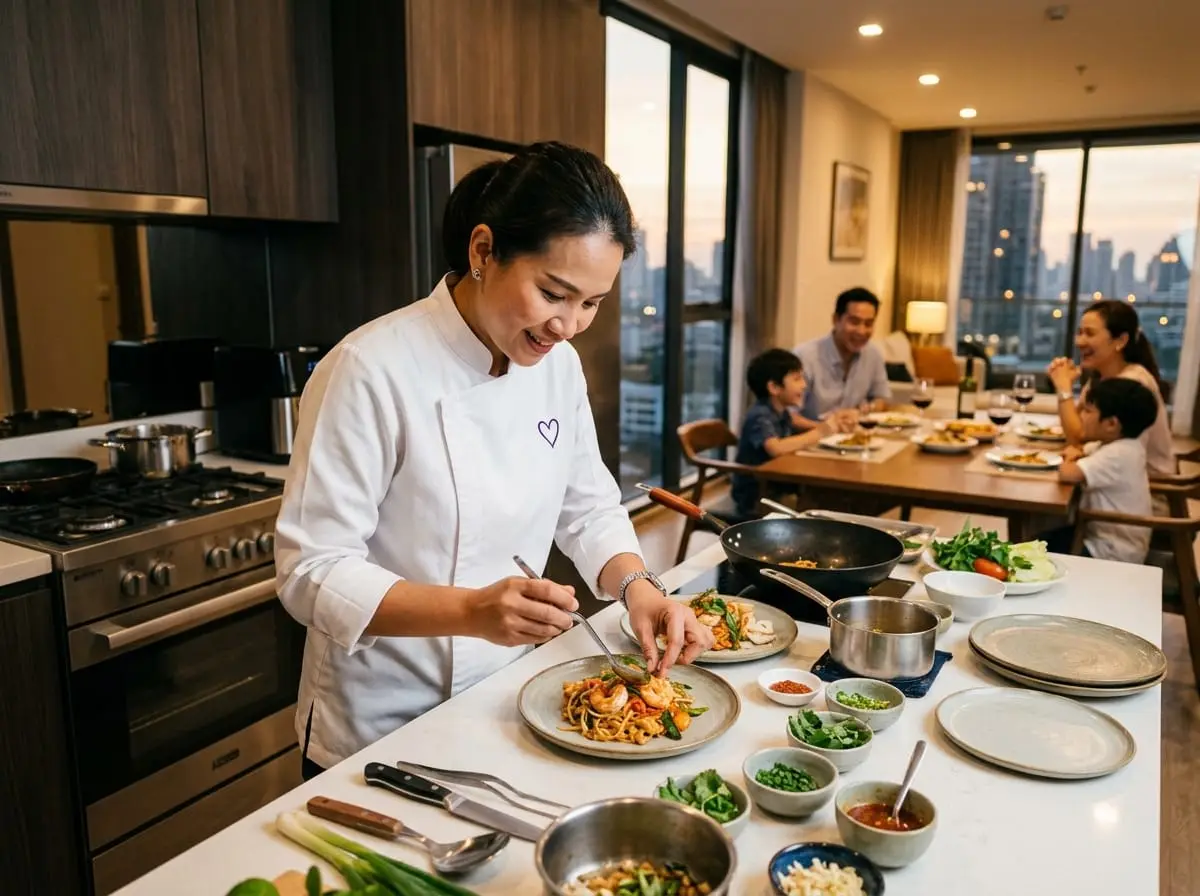
Of all the chef formats, the weekly meal prep chef in Bangkok is the one they most often keep. One visit a week, four to six hours, and the fridge and freezer are full of labelled dinners, lunches and snacks for the days ahead. No daily cook in the house, no delivery apps every night, and no one standing in front of an open fridge at 19:00 wondering what is safe to eat.
It only works if the food is still safe on day four. Batch cooking in a 32 °C kitchen and storing it in a fridge that gets opened forty times a day is a food-safety exercise as much as a cooking one.
This guide explains how the visit runs, how a chef plans a week for a family of four, the container and label system we ask CareRova chefs to use, how long each dish really keeps, and what it costs.
How a weekly meal-prep visit works
The visit has a shape, and most good chefs follow something close to it. The menu is agreed two or three days before, the chef shops the morning of the visit or the day before, and the cooking happens in one block.
| Time | What the chef is doing |
|---|---|
| Before the visit | Menu sent on Friday, family edits it, shopping list agreed |
| 09:00 | Arrives with groceries, checks fridge temperature, clears out last week's leftovers |
| 09:15 | Washes down counters and sink, sets out colour-coded boards, starts rice and stocks |
| 09:30–11:30 | Prep: vegetables first, then raw meat on its own board, then fish |
| 11:30–13:00 | Cooking: oven trays, curries and soups at once, two burners, one oven |
| 13:00–14:00 | Cooling in shallow trays and ice baths, portioning, labelling |
| 14:00 | Everything in the fridge or freezer by fridge map, kitchen cleaned |
| 14:30 | Photo of the fridge and a list of "eat first" items sent to the family |
That is a five-and-a-half-hour visit. A couple or a small family can be done in four. A family of five with lunches and toddler food needs six.
What the chef needs from you
- A fridge that is not already full. Clear a shelf and half the freezer the night before.
- Containers: 20 to 30 glass or BPA-free plastic boxes with lids, in two or three sizes, plus freezer bags.
- A working oven, or tell the chef in advance so the menu is built for the hob and rice cooker.
- A fridge thermometer. It costs less than a takeaway and it tells you more about food safety than anything else in the kitchen.
Hygiene on prep day
A prep day handles more raw food in five hours than most home kitchens see in a week, so the order of work matters. Vegetables and anything eaten raw are prepped first, on a clean green board. Raw chicken, pork and beef come next on the red board, then fish on the blue one, with the sink and counter wiped down between each.
The chef washes hands with soap for 20 seconds at every switch: after raw meat, after the bin, after touching a phone, before portioning cooked food. Raw meat is never rinsed under the tap, because the splash spreads bacteria across the sink. Tea towels used on raw-meat hands do not touch clean plates; disposable paper towels are simpler.
A chef who has had vomiting or diarrhoea stays away until 48 hours after the last symptom and the visit is moved. One week of meal prep cooked by someone carrying norovirus can make a whole household ill.
Where the chef shops
Most of our meal-prep chefs shop at a wet market for vegetables, herbs and fish, then at Tops, Villa Market or Gourmet Market for dairy, imported items and the family's brands. Groceries go on a family card or are reimbursed from photographed receipts at cost. Our guide to how a private chef's costs work explains the grocery options in detail.
Planning a week for a family of four
The trick to a good meal-prep week is that not everything gets cooked to the finish. Some dishes are cooked fully and portioned. Some are cooked as components and finished in ten minutes on the night. Some are frozen for later in the week.
Here is a typical week for two adults, a seven-year-old and a four-year-old, with a prep visit on Monday.
| Day | Dinner | How it is stored | Finish on the night |
|---|---|---|---|
| Monday | Chicken and vegetable green curry, jasmine rice | Fridge, rice cooked fresh | Reheat curry; children's portion made without chilli |
| Tuesday | Baked salmon, roast potatoes, broccoli | Fridge, salmon portioned | 10 minutes in the oven |
| Wednesday | Pork and ginger stir-fry, noodles | Raw marinated pork in fridge, vegetables cut | 8 minutes in a wok |
| Thursday | Beef and lentil bolognese, pasta | Frozen on Monday, moved to fridge Wednesday night | Boil pasta, reheat sauce |
| Friday | Tom kha soup and chicken skewers | Soup frozen, skewers frozen raw | Defrost overnight, grill skewers |
| Saturday | Family's night out or cook together | - | - |
| Sunday | Vegetable frittata, salad | Frittata cooked Monday, frozen | Reheat, dress salad fresh |
On top of dinners, a five-hour visit usually covers school snacks (banana bread, boiled eggs, cut vegetables), a batch of overnight oats, and two lunches for an adult working from home.
The rule of three days
Most cooked dishes keep three to four days. So the chef cooks for days one to three and freezes for days four to six. Fish goes early in the week; robust braises and sauces go late, frozen. Raw marinated meat for a quick stir-fry is cooked within two days.
Children's portions
Children get the same food with less salt, no chilli and simpler textures. The chef portions their meals separately before seasoning the adults' share, rather than trying to take the heat out later. If you also want help with school lunches, our guide on nanny cooking and lunchboxes for international-school mornings covers the lunchbox side.
Who this format suits
Weekly meal prep is popular with working couples in Silom and Sathorn condos, where kitchens are small but the fridge is decent and nobody is home to cook at 18:00. It also suits families whose nanny handles breakfast and lunch but not dinner.
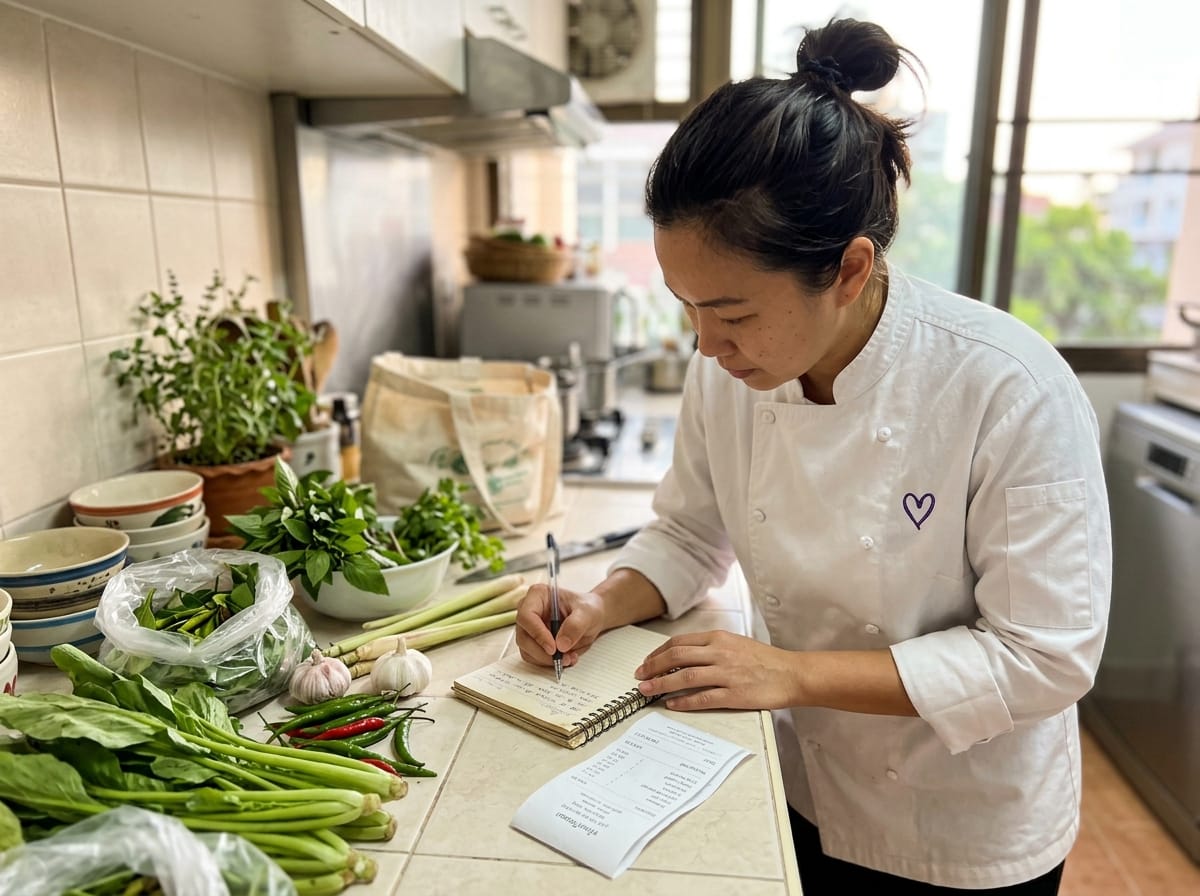
The container, label and fridge-map system
The difference between meal prep that works and meal prep that ends up in the bin is organisation. Three things make it work.
Labels on everything
Each container gets a strip of masking tape or a printed label with:
- Dish name in the family's language, plus the nanny's or housekeeper's if different.
- Date cooked.
- Use by as a day of the week, not a date. "Use by THU" is read; "Use by 23/10" is not.
- Allergens in capitals: NUTS, SESAME, SHELLFISH, DAIRY, EGG, GLUTEN.
- Reheat note: "Oven 180 °C, 15 min" or "Microwave, stir halfway".
Frozen items add "Freeze date" and "Move to fridge on…" so the person who defrosts it knows when.
The fridge map
A photo on the fridge door showing where everything goes. The logic is simple: things that are eaten without cooking go higher, things that will be cooked go lower, and raw meat goes on the bottom shelf where its juices cannot drip onto anything.
- Top shelf: ready-to-eat food, cooked meals for today and tomorrow, children's snacks.
- Middle shelf: cooked meals for days three and four, dairy, eggs.
- Bottom shelf: raw meat and fish in sealed containers on a tray.
- Drawers: vegetables and fruit, washed only when about to be used.
- Door: sauces, drinks and condiments. Not milk, not breast milk, not leftovers. The door is the warmest part of the fridge.
Glass or plastic
Glass containers with clip lids are our first choice. They do not stain with turmeric or chilli oil, go from fridge to oven, and are easy to check for cleanliness. Their weakness is weight and breakage, which matters in a household with toddlers.
Good-quality plastic is fine for the freezer and for children's portions. Replace boxes that are cracked, cloudy or scratched deep enough to hold grease, and reheat food on a plate rather than in old plastic. Wash every container in hot soapy water and let it air-dry fully before the next prep day; a damp box sealed in a humid cupboard grows mould on the lid seal.
Allergens in a shared fridge
If one family member has a food allergy, their meals go in containers of one colour, on one shelf, with lids that close properly. The chef cooks allergen-free dishes first, on clean boards, before handling the allergen. The UK Food Standards Agency's food allergy guidance explains the 14 major allergens and why cross-contact matters as much as ingredients.
Cooling, chilling and the 5 °C fridge
This is the part of meal prep most home cooks get wrong, and the part that matters most in Bangkok. Large pots of curry or soup left on the hob to "cool down" sit for hours in the temperature danger zone between 5 °C and 60 °C, where bacteria double fast. In a kitchen that is already 30 °C, a pot of rice or curry barely cools at all on its own.
The two-hour cooling rule
Cooked food should be in the fridge within two hours of cooking, and cooling as fast as possible within that window. A chef does this in four ways:
- Shallow containers. Food spread no more than about 5 cm deep cools many times faster than a deep pot.
- Ice baths. The pot of soup goes into a sink of ice and water, stirred every few minutes, until it stops steaming.
- Split large batches. A three-litre curry becomes six half-litre boxes before it goes in the fridge.
- Lids on once cool to the touch, not while steaming hot. Lids trap heat and condensation.
Putting warm food into the fridge is fine and much safer than leaving it out. What a fridge cannot handle is ten litres of hot food at once. Stagger it, and keep the door shut while it works.
Is your fridge at 5 °C
Many Bangkok condo fridges run warmer than their owners think, especially older units, fridges in hot kitchens with no aircon, and fridges packed too full for air to circulate. The FDA's guide to refrigerator thermometers recommends keeping the fridge at or below 4 °C to 5 °C and the freezer at -18 °C.
Put a thermometer on the middle shelf and check it first thing in the morning, before anyone opens the door. If it reads 7 °C or 8 °C, turn the dial down and check again the next day. Our chefs check it at the start of every visit and tell you if it is drifting.
Power cuts and the Bangkok fridge
Short power cuts happen, particularly in older buildings and during storms. The rules from FoodSafety.gov's cold storage guidance and USDA are clear:
- A closed fridge keeps food safe for about four hours.
- A full freezer holds for about 48 hours; a half-full one for about 24.
- Do not open the door to check. Every opening costs cold air.
- When power returns, check the fridge thermometer. Perishable food that has sat above 5 °C for more than two hours should be thrown away, even if it looks and smells fine.
A full freezer is your insurance. If the meal prep leaves gaps, fill them with bottles of water.
How long everything keeps: a storage chart
These are the working limits our chefs label against. They follow the US cold food storage charts and the USDA's leftovers guidance, with stricter limits on rice and dressed food because of Bangkok kitchen temperatures.
| Food | Fridge at 5 °C or below | Freezer at -18 °C | Notes |
|---|---|---|---|
| Cooked chicken, pork, beef | 3–4 days | 2–6 months | Freeze in meal-sized portions |
| Curries, stews, bolognese | 3–4 days | 2–3 months | Freeze before adding fresh herbs |
| Soups and broths | 3–4 days | 2–3 months | Leave headroom in freezer boxes |
| Cooked fish | 1–2 days (our limit) | 1–3 months | Eat early in the week |
| Cooked rice | 1 day (our limit) | 1 month | Cool within an hour if you can |
| Cooked pasta, plain | 3–4 days | 1–2 months | Toss lightly in oil |
| Hard-boiled eggs, in shell | 1 week | Do not freeze | Peel on the day |
| Raw marinated meat | 1–2 days | 3–4 months | Bottom shelf, sealed |
| Dressed salads | Same day | Do not freeze | Dress at the table |
| Cut fruit | 2–3 days | 6 months for smoothies | Melon and papaya spoil first |
Freezing well
Freeze food flat in bags or shallow boxes so it freezes fast and defrosts evenly. Label with the freeze date. Defrost in the fridge overnight, never on the counter. In a Bangkok kitchen, a box of frozen curry on the counter is in the danger zone on the outside within an hour while the middle is still frozen.
Reheating safely and the rice problem
Every meal-prepped dish eventually gets reheated, usually by a tired adult or a nanny with a toddler on one hip. The rules have to be simple enough to follow at 19:00.
Reheat to 74 °C, once
Leftovers should be reheated until steaming hot all the way through, which means 74 °C in the centre according to the safe minimum internal temperatures chart. In practice:
- Microwave: cover, heat, stir halfway, heat again and let stand for a minute. Microwaves leave cold spots.
- Hob: bring sauces, soups and curries to a rolling boil.
- Oven: 180 °C until the centre is hot; check with a probe for thick items like lasagne.
- Reheat once. Take out the portion you will eat; do not reheat the whole box and put the rest back.
Why rice gets its own rule
Raw rice often carries spores of Bacillus cereus. Cooking does not kill the spores. If cooked rice then sits warm, the spores germinate and the bacteria produce a toxin that reheating does not destroy. The result is vomiting within a few hours, which the NHS food poisoning page describes in more detail.
In a Thai household the classic risk is rice left in a switched-off rice cooker on a warm counter all afternoon. Our meal-prep rules for rice:
- Cook rice fresh on the day where you can; a rice cooker makes this easy.
- If rice is prepped, spread it on a tray to cool, then box and refrigerate within an hour.
- Eat refrigerated rice within one day.
- Reheat it once, steaming hot throughout. Fried rice counts as reheating.
- Never refreeze rice that has been defrosted.
The same logic applies, less severely, to pasta and noodles. Our vegan private chef guide goes further on rice, legumes and batch cooking for plant-based households.
Signs to throw something out
Smell is not a reliable test. Many of the bacteria that cause food poisoning do not change the smell or look of food. Use the label. If the "use by" day has passed, it goes, and the chef plans the next week so that it does not happen often.
Nutrition: building balanced weeks without boredom
A meal-prep chef has one real advantage over delivery: control of what goes in. The aim is not a diet; it is a week of meals the family actually eats that happens to be balanced.
The plate as a planning tool
Harvard's Healthy Eating Plate from the Nutrition Source is the simplest framework we have found for briefing a chef. Half the plate vegetables and fruit, a quarter whole grains, a quarter protein, healthy oils, and water instead of sweet drinks. A chef can plan a whole week against it, and parents can see at a glance whether it is working.
Rotation, not repetition
Families get bored of meal prep when the same five dishes come round every week. A rotation grid fixes this. Each week rotates protein (chicken, fish, pork, beef, eggs, tofu, lentils), cuisine (Thai, Japanese, Italian, Indian, Middle Eastern, simple British) and cooking method (curry, roast, stir-fry, soup, bake). No two dinners in the same week share all three.
Salt, sugar and children
Batch-cooked food tends to be saltier than food cooked fresh, because seasoning concentrates as sauces reduce and as food sits. Ask the chef to under-season and put fish sauce, soy and salt on the table. For children, the American Academy of Pediatrics' nutrition advice on HealthyChildren.org is a practical guide to salt, sugar and portion sizes by age.
Vegetables that survive four days
Not every vegetable holds. Roast root vegetables, braised greens, cooked beans and lentils, and sturdy salads like cabbage slaw last well. Delicate leaves, cucumber and tomato go soggy. The chef preps sturdy vegetables in advance and leaves raw salad items whole, washed only on the day.
What it costs and how to start
CareRova chefs are booked by the hour or the day for meal prep, and on a monthly part-time contract when a family wants more than one cook day. Groceries are always separate.
| Format | What you get | Guide rate |
|---|---|---|
| Weekly visit, 4 hours | Dinners for a couple or small family, Mon–Thu | ฿900 an hour (฿3,600) |
| Weekly visit, 6 hours | Dinners, snacks and lunches for a family of four | ฿4,900 day rate applies |
| Part-time chef, 3 days a week | Two prep days plus one fresh-cooked evening, or three evenings | ฿19,900 a month |
| Full-time live-out chef | Daily cooking, 5–6 days | ฿34,900 a month |
A weekly visit every week works out at roughly ฿14,400 to ฿19,600 a month before groceries, so families who want more than one visit a week are usually better off on the part-time rate. The full rate card is on our pricing page.
Your first meal-prep visit checklist
Send us these and we will match a chef:
- Number of people, ages and how many meals a week you want covered.
- Allergies, intolerances and any medical diets (low sodium, diabetic, low FODMAP).
- Cuisines the family eats in a normal week, and three dishes everyone likes.
- Your preferred prep day and the kitchen set-up: oven or not, fridge and freezer size.
- Whether a nanny or housekeeper will be reheating meals, and which language the labels should be in.
- Your area and building, so we can match a chef who shops nearby.
Every chef on our private chef service holds food-hygiene certification, has passed a police background check and has had references phoned. For any ongoing arrangement, the first visit is a paid trial so you can judge the food and the kitchen discipline before committing. Our private chef hygiene standards guide sets out what to check on that first day.
CareRova sends a shortlist within 48 hours. Message us on WhatsApp or call +66 97 120 3054, or use the contact form, and tell us what a good week of food looks like in your house.
Frequently asked questions
How much does a meal prep chef cost in Bangkok?
CareRova's guide rate is ฿900 an hour with a four-hour minimum, or ฿4,900 for a day, so a weekly visit of four to six hours costs ฿3,600 to ฿4,900 plus groceries. Families who want more than one cook day a week usually move to part-time at ฿19,900 a month.
How long does cooked food last in the fridge?
Most cooked meat, poultry, curries, stews and soups keep three to four days at 5 °C or below. Cooked rice and dressed salads should be eaten within a day. Anything planned for later in the week should be frozen on prep day.
Is it safe to reheat rice?
Yes, if it was cooled quickly, kept in the fridge and eaten within a day, and it is reheated once until steaming hot all the way through. Rice left out at room temperature can grow Bacillus cereus, whose toxins are not destroyed by reheating.
What happens to meal-prepped food during a power cut?
A closed fridge keeps food cold for about four hours. A full freezer holds for about 48 hours and a half-full one for about 24. Keep the doors shut, and discard perishable food that has been above 5 °C for more than two hours.
Can a meal prep chef cook for allergies and children?
Yes. The chef plans the menu around allergies, cooks the allergen-free dishes first with clean equipment, labels allergens on every container and keeps children's portions plainer and lower in salt.
Need someone properly vetted?
Get a written rate for your household in under 60 seconds.
Written by the CareRova team
We're Bangkok's vetted home-care agency — everything we write comes from real nanny, chef, housekeeper and senior-care placements across condos, houses and short-stay villas.
Get our Bangkok family-care guides straight in Google — add CareRova as a preferred source.