
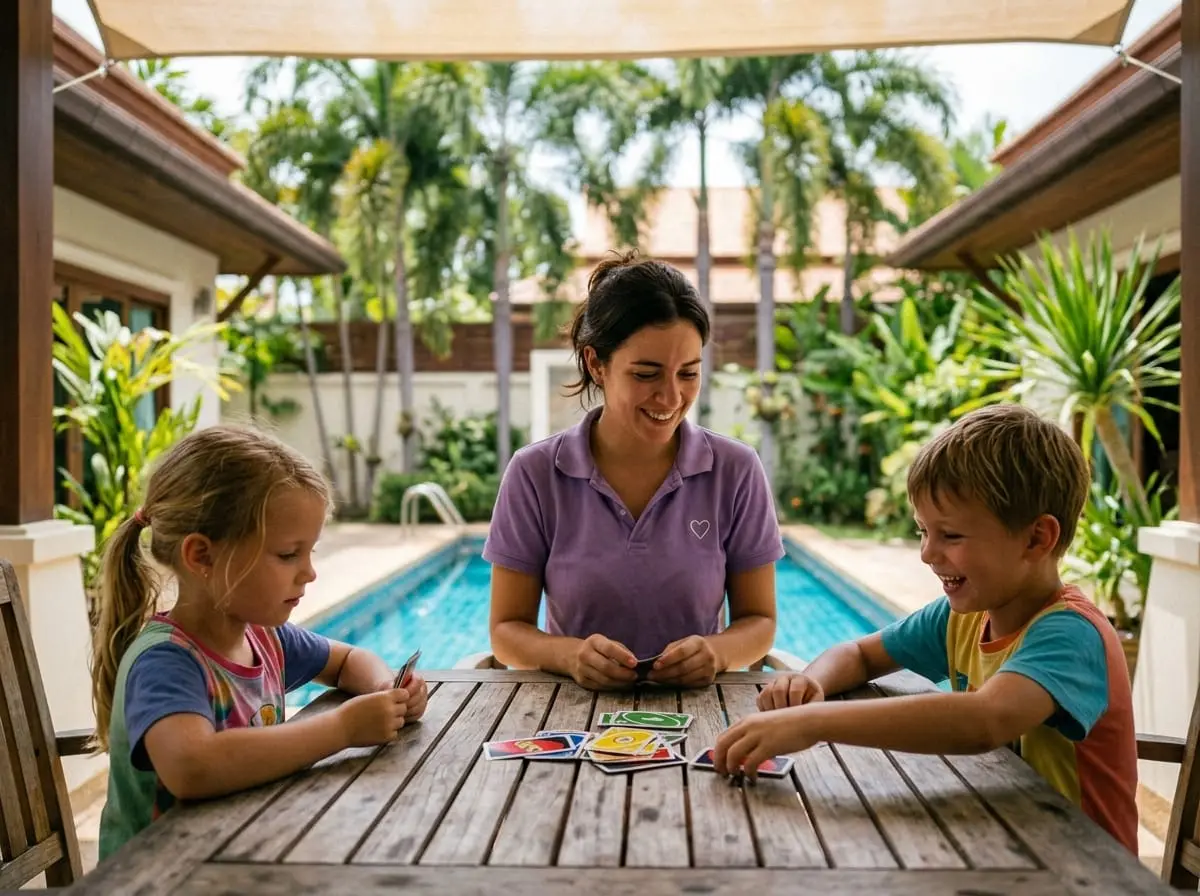
A travel nanny in Thailand turns a beach week with a toddler from shift work into an actual break. Bangkok families do it all the time: a long weekend in Hua Hin, a week on Koh Samui, Songkran in Phuket, a cool-season escape to Khao Yai or Chiang Mai. The nanny keeps the routine going so the parents can swim, sleep and finish a meal while it is still warm.
It works when the terms are clear before you pack. Who pays for her flight and room, how many hours she works when everyone is "on holiday", when her day off falls, and what happens on the evening you want to go out for dinner. Those questions cause more holiday friction than any delayed flight.
This guide covers both ways of having a nanny on a Thai holiday, the money and the hours, and the health side: pools and beaches, sun and heat, mosquitoes away from the city, and food and water on the road.
Two ways to have a nanny on a Thai holiday
Bring your own nanny from Bangkok
The child already knows and trusts her, she knows the routine, and you know how she handles a tired toddler at 18:00. For under-threes and for children who find change hard, this is usually the better choice. The cost is everything she needs to be away: transport, room, meals, and the hours you ask of her.
If your regular nanny is a CareRova placement, tell us about the trip early. We will talk through dates, hours and arrangements with you and with her, and quote anything beyond the normal placement on request.
Book a holiday nanny or sitter at the destination
This suits families without a regular nanny, families visiting Thailand from abroad, and older children who settle easily with someone new. CareRova's StayCare service places holiday nannies and evening sitters for villa, hotel and Airbnb guests. Our core service area is Bangkok, so for Phuket, Samui, Hua Hin or elsewhere, ask us what we can arrange for your dates rather than assuming. Our guide to holiday nannies for visiting families covers the Bangkok side of this in detail.
| Bring your own nanny | Holiday nanny at the destination | |
|---|---|---|
| Child's comfort | High, familiar carer | Needs a settling-in hour or two |
| Routine | Continues unchanged | Has to be explained, ideally in writing |
| Costs beyond pay | Transport, room, meals | Usually none, she lives locally |
| Flexibility | High, she is with you all week | Set by booked days and hours |
| Best for | Babies, toddlers, long trips | Older children, short stays, evening cover |
| Vetting | Already done | Ask exactly what checks were made |
Settling a new nanny in on day one
A holiday nanny who has never met your children needs a proper handover, not a name at the door. Book her first session while you are still there, so the children meet her with a parent in the room. Walk her round the villa or suite: the pool gate, the balcony, where the medicines and first-aid kit are, how the air conditioning and the cot work. Give her a one-page note with routines, foods, allergies, medicines with written consent, your numbers and the nearest hospital, and stay for the first hour before going out.
Hotel babysitting services vary a lot. If you use one, ask what background checks, first-aid training and references the sitter has, and do not assume a resort uniform means any of those things. Every CareRova carer has a police background check, ID and work-eligibility check, at least two references phoned and first aid and CPR.
Who pays what: travel, room, meals and working hours
The principle is simple: when the nanny travels for your family's benefit, she should not be out of pocket for any of it. Families who get this right tend to keep their nannies for years.
| Cost | Common practice | Note |
|---|---|---|
| Transport | Family pays: flights, train, van or fuel, airport transfers | Book her seat with the family so she can help with the children |
| Accommodation | Family pays; her own room, or at minimum her own bed | She should not share a bed with the children |
| Meals | Family pays all meals and drinking water | Meal breaks are breaks, not mealtimes spent feeding the children |
| Pay | Normal pay continues for every day away | Agree in advance any extra for long days or evenings |
| Phone and data | Family covers any extra cost if she needs data for work | Useful for maps and messaging |
| Travel insurance | Discuss with your insurer whether she can be covered | Ask before booking, not at the airport |
| Medical costs on the trip | Agree who pays if she falls ill while away | Write it down |
Her room
A shared family villa with a separate nanny room is ideal. In a hotel, a connecting room works well: she has privacy and a door to close, and she is next door if a baby wakes. Asking a nanny to sleep on a sofa bed in the family's room for a week is a common mistake; she will be tired, and tired carers miss things.
Working hours on the trip
Holidays tend to stretch a nanny's day: an early flight, a late dinner, a baby who will not settle in a new cot. Before you go, agree a daily pattern in writing. A common one is the normal working day with a long break in the middle while the children nap or swim with a parent, and a clear finish time.
| Time | Nanny | Parents |
|---|---|---|
| 07:00 to 09:30 | Breakfast, sunscreen, morning play in the shade | Breakfast, gym or a walk |
| 09:30 to 11:00 | Beach or pool, one adult watching each young child | One parent in the water too |
| 11:00 to 15:00 | Lunch, then her break while the children nap | Lunch, nap watch, pool time |
| 15:00 to 18:00 | Afternoon play, early dinner, bath | Free time |
| 18:00 to 19:30 | Bedtime routine, then off duty | Dinner out from 19:30 if a sitter is booked |
Days off and overtime on a trip
Thai rules give domestic workers at least one day off a week, paid public holidays and sick leave. None of that pauses because the family is at the beach, and the Department of Labour Protection and Welfare is the body responsible for labour protection if you want to read further. Our guide to nanny contracts in Thailand covers how to write travel terms into the employment agreement.
Planning the day off
On a trip of six days or more, put her day off into the itinerary on a day the family can manage alone, such as a quiet pool day. Agree whether she stays at the resort, explores, or travels home early. A day "off" spent in the family's villa watching the children because there is nowhere else to go is not a day off.
Overtime and evenings
There is no single holiday overtime rate, so agree one before you leave. Common practice is either a flat extra payment per trip day, or an hourly rate for any time beyond the agreed finish. Put the figure in writing and pay it at the end of the trip, not "later".
If the nanny falls ill on the trip
Sick leave applies away from home as it does in Bangkok. A nanny with a fever, vomiting or diarrhoea stops caring for the children and preparing food, and rests in her own room. The family pays for her to see a doctor if needed, as agreed before the trip, and decides whether she recovers at the resort or travels home. Build a little slack into the plan: a parent who can take over for a day, or a local sitter booked for the gap.
If you want regular evenings out, consider booking a separate evening sitter rather than stretching your nanny to a 14-hour day. In Bangkok, CareRova's babysitter service covers evenings from four hours. For travel, ask us about your destination.
Pools, beaches and water safety for small children
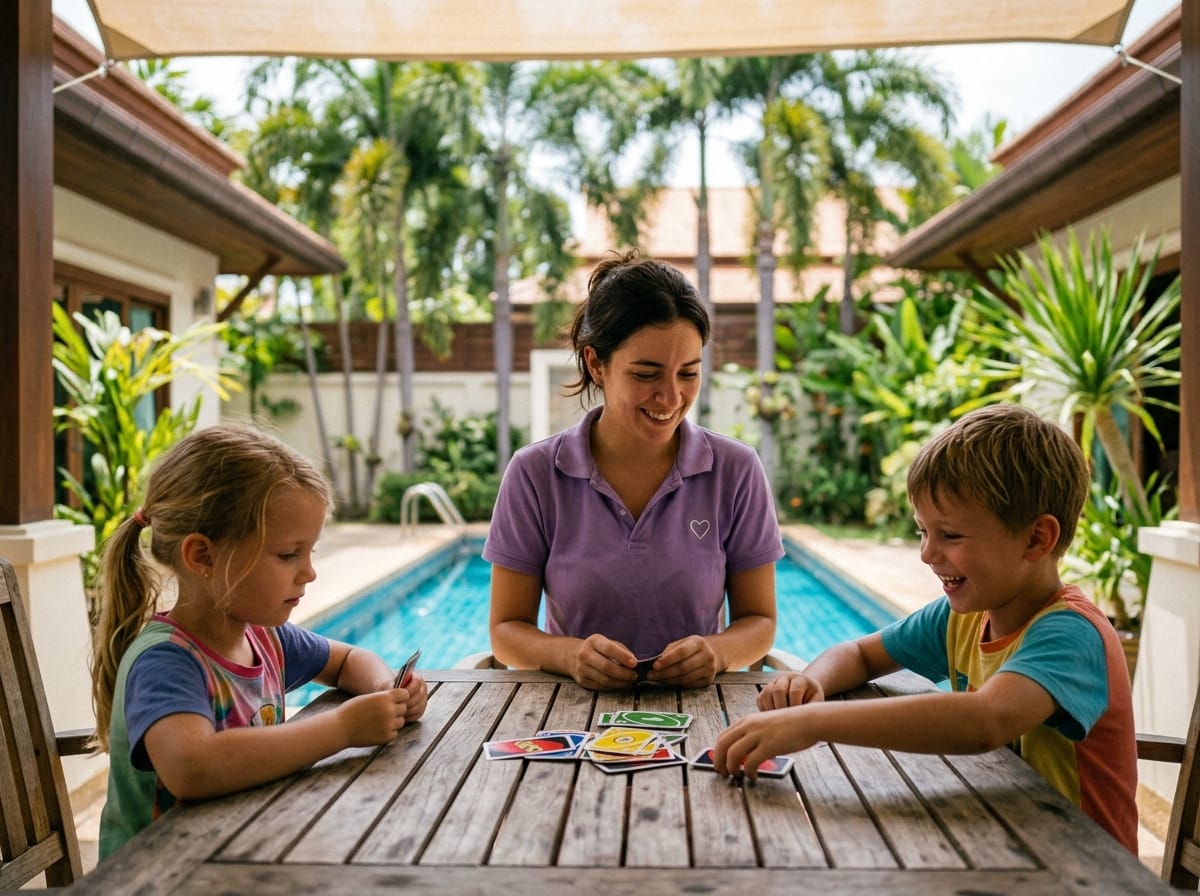
This is the part of the trip where we would ask you to be strict. Children drown quickly and silently, often in shallow water and often when several adults are nearby but nobody is actually watching. The American Academy of Pediatrics' home safety pages and Safe Kids Worldwide make the same point in every water-safety guide: active, close, undistracted supervision.
The water rules we suggest
- One named watcher per young child. At the pool, say out loud who is watching whom. "Nanny has Mia, I have Leo" beats "we're all here".
- Touch distance for non-swimmers and toddlers. In the water, close enough to reach without stretching.
- Phones away while watching. If the watcher needs her phone, she hands over the child first.
- No child alone near water, ever. Including villa pools at breakfast, ornamental ponds and bathtubs.
- Armbands are not supervision. Inflatables give a false sense of safety.
- Check the villa pool on arrival. Is there a fence, a gate that latches, or a pool alarm? If not, the pool doors stay locked and the key goes high.
Beaches
Sea conditions change by coast and season. On Phuket's west-coast beaches, the south-west monsoon months bring strong currents, and red flags mean nobody swims. Follow the flags and lifeguards wherever you are, and ask the hotel about local hazards such as jellyfish before the children go in.
Boats and island trips
Island-hopping and snorkelling trips are a highlight of Samui and Phuket, and the riskiest part of a beach holiday for small children. Before you book, ask the operator whether they carry life jackets in your children's sizes, not just adult ones; if in doubt, bring your own. Every child under about eight wears one on the boat and on the pier, not just in the water. The nanny sits with the youngest, away from the edge, and the family agrees who is responsible for each child at every transfer between boat, beach and van.
First aid by the water
Your nanny should hold a current first aid and CPR certificate, which CareRova requires for every child carer. The Red Cross child and baby CPR guide is worth reading together before the trip, and our guide to nanny first aid and child safety covers the training and kit in more depth. Save the local emergency number 1669 and the nearest hospital in both your phones on day one.
Sun, heat, mosquitoes and dengue away from Bangkok
Sun and heat
Resort sun is stronger than condo sun because children are outside all day, near water and sand that reflect it. Plan outdoor play before about 10:00 and after 16:00, with shade, hats and water in between. Babies under six months are kept out of direct sun; older children need a broad-spectrum sunscreen reapplied after swimming, plus a sun shirt. The American Academy of Pediatrics publishes sun-safety advice for parents that your nanny can follow.
Fluids matter more than parents expect. Offer water every 20 to 30 minutes when children are playing outside, more after swimming, because children rarely ask until they are already thirsty. Pale urine is the simplest check the nanny can make. Breastfed babies may want more frequent feeds in the heat rather than water.
Watch for heat exhaustion: a flushed or unusually pale child, headache, vomiting, unusual tiredness or a child who stops sweating. Move them to shade or air conditioning, cool them with water, give sips of fluid and call a doctor if they do not improve quickly.
Mosquitoes and dengue
Dengue is not just a Bangkok problem. It is common across Thailand, and island and beach resorts have mosquitoes too. The WHO's dengue fact sheet explains that the mosquitoes that spread it bite mainly in the daytime, so dusk-only repellent is not enough. The CDC's dengue pages list the warning signs, and Thailand's Department of Disease Control publishes local advice.
Practical rules for the nanny:
- Repellent on exposed skin after sunscreen, reapplied as the label says, using the product the parents have chosen for the child's age.
- Light long sleeves and trousers at dawn and dusk.
- Check the room for screens or keep doors closed with the air conditioning on; use a cot net if the room is open.
- Empty any water standing in buckets, sand toys or saucers on the villa terrace.
- A child with a sudden high fever during the trip, or in the two weeks after, sees a doctor. Paracetamol only, at the label dose, unless a doctor advises otherwise; avoid ibuprofen when dengue is possible.
Air quality up north
If you travel to Chiang Mai or the north in the dry months, smoke from seasonal burning can make the air worse than Bangkok's. Check readings on the Pollution Control Department site and plan more indoor time on bad days.
Food and water hygiene on the road
Stomach bugs ruin more family holidays than anything else, and small children dehydrate faster than adults. The nanny's job is to keep the basics going even when the kitchen is a hotel room.
Hands first
Handwashing with soap for at least 20 seconds before eating, after the toilet or nappies, after the beach and after touching animals, as the CDC's handwashing guidance sets out. Keep sanitiser in the beach bag for when there is no tap, then wash properly at the next sink.
Eating out with children
The WHO's food safety fact sheet sums up the principles: keep clean, separate raw and cooked, cook thoroughly, keep food at safe temperatures and use safe water. On a trip that means:
- Choose busy places where food is cooked to order and served hot.
- Be careful with buffet food that has sat out for hours in the heat, especially rice, seafood and anything creamy.
- Peel fruit yourself, or choose fruit that is peeled in front of you.
- Give children sealed bottled water; use it for brushing teeth too if you are unsure of the tap water.
- Shellfish and raw dishes are best avoided for young children.
Food in the room
If the nanny is preparing baby food or snacks in the room, check the minibar fridge is actually cold, at 5 °C or below; many are not. Anything perishable that has been out of the fridge for two hours is thrown away, and less in the afternoon heat. Bottles are washed and sterilised as at home, using a travel steriliser or cold-water sterilising tablets.
Hepatitis A spreads through contaminated food and water; the WHO's hepatitis A fact sheet explains why vaccination is worth discussing with your doctor before travel, for the family and for a nanny who prepares food.
When a stomach bug hits
Small, frequent sips of oral rehydration solution are the main treatment, as the NHS food poisoning guidance explains. Go to a doctor for a baby who is feeding poorly, any child with signs of dehydration (few wet nappies, dry mouth, no tears, unusual sleepiness), blood in the stool, or vomiting that does not stop. A nanny with vomiting or diarrhoea stops preparing food and stays away from the children until 48 hours after the last episode.
The Bangkok Hospital group has hospitals in several resort areas, including Phuket, Samui and Hua Hin; find the nearest one before you need it.
The packing list for travelling with a nanny
| Item | Why | Who packs it |
|---|---|---|
| Nanny's ID card or passport, plus work permit if she is foreign | Domestic flights, hotel check-in, her legal status | Nanny, checked by parents |
| Written trip terms: hours, day off, extra pay | Avoids arguments mid-trip | Parents |
| Child's medicine, dosing chart and written consent | She can act without calling you | Parents |
| Thermometer, children's paracetamol, oral rehydration salts | Fever and stomach bugs | Parents |
| Repellent and broad-spectrum sunscreen | Dengue and sunburn | Parents |
| Sun hats, sun shirts, swim nappies | Sun and pool | Nanny |
| Travel steriliser or sterilising tablets, bottle brush | Baby bottles | Nanny |
| Insulated bag and ice packs | Milk and snacks on the road | Nanny |
| Small first-aid kit with plasters, antiseptic, tweezers | Beach cuts and splinters | Parents |
| Emergency card: 1669, nearest hospital, both parents' numbers | Any emergency | Both |
| Copy of children's passports or ID and insurance details | Hospital visits | Parents |
| Familiar comforter, white-noise app, night light | Sleep in a new room | Nanny |
Before you leave
- Agree the written trip terms and give her a copy.
- Book her transport and room at the same time as yours.
- Share the itinerary with her day by day, including her day off.
- Check her insurance position with your insurer.
- Brief her on each pool and beach rule, out loud.
Rates and how to arrange it
CareRova rates that apply to trips
| Service | Rate (2026, all-in) |
|---|---|
| StayCare holiday nanny, per day | ฿2,900 |
| StayCare holiday nanny, six days | ฿15,900 |
| StayCare evening sitter, 4 hours | ฿1,900 |
| Nanny, daily (8-hour day) | ฿2,900 |
| Nanny, full-time live-out, per month | ฿29,900 |
| Nanny, live-in, per month | ฿26,900 |
Travel, room and meals for a nanny who travels with you are paid by the family on top of these rates. Arrangements outside Bangkok are quoted on request, so ask us before you book flights. The full rate table is on our pricing page, and hosts who want to offer childcare to villa or hotel guests can read our page for hosts.
What to send us
- Destination, dates and where you are staying.
- Children's ages, routines and any allergies or medical needs.
- Whether you want your current nanny to travel, or a nanny at the destination.
- The daily hours you need, and any evenings out.
- Pool, beach or boat plans, so we brief the nanny on water safety.
We shortlist within 48 hours, and every carer is vetted and first-aid trained. Read more about our nanny service, then WhatsApp or call +66 97 120 3054, email support@carerova.com, or use the contact form.
Frequently asked questions
Can I take my nanny on holiday in Thailand?
Yes, many Bangkok families do. Agree in writing before you go who pays her travel, room and meals, her working hours on the trip, her weekly day off and any extra pay for evenings. A foreign nanny should carry her passport and work permit.
Who pays for the nanny's room and food on a family trip?
The family. Common practice is that the employer pays all of the nanny's transport, accommodation and meals while she is away for work. She should have her own room, or at minimum her own bed, and proper meal breaks.
How much does a holiday nanny cost in Thailand?
CareRova's StayCare holiday nanny is ฿2,900 a day or ฿15,900 for six days, and an evening sitter is ฿1,900 for four hours. For trips outside Bangkok, ask us what we can arrange at your destination, or about bringing a CareRova nanny with you.
Does my nanny get a day off when we travel?
Yes. Domestic workers in Thailand are entitled to at least one day off a week, and that applies on trips too. Schedule it on a quiet day of the itinerary, and agree whether she stays at the resort or travels home.
How do I keep my child safe from dengue on a beach holiday?
Use repellent through the day as well as at dusk, choose rooms with screens or air conditioning, and cover arms and legs at dawn and dusk. Dengue mosquitoes bite in daylight. A child with a sudden high fever during or after a trip should see a doctor.
Need someone properly vetted?
Get a written rate for your household in under 60 seconds.
Written by the CareRova team
We're Bangkok's vetted home-care agency — everything we write comes from real nanny, chef, housekeeper and senior-care placements across condos, houses and short-stay villas.
Get our Bangkok family-care guides straight in Google — add CareRova as a preferred source.