

A nanny share in Bangkok is one of the smartest arrangements we see, and one of the easiest to get wrong. Two families, usually neighbours in the same condo or friends from a baby group, employ one nanny together. The children get a playmate and a familiar carer, the nanny earns more than she would from one family, and each family pays far less than a full-time nanny on its own.
It goes wrong for predictable reasons: a sick child nobody agreed a rule for, a family holiday that leaves the nanny's pay in doubt, two sets of snack rules, or a baby who suddenly needs far more attention than the toddler she shares a nanny with.
This guide covers who a share suits, ages and ratios, whose home the children use, what it costs and how to split it, the written agreement, sick-day rules between two households, and the hygiene that keeps two families' children from passing every bug back and forth.
What a nanny share is and who it suits in Bangkok
In a true share, one nanny cares for two families' children at the same time. A split week, where she works Monday to Wednesday for one family and Thursday to Saturday for another, is simply two part-time jobs; a share is one job with two employers and one set of rules.
The families we see make shares work usually have three things in common. They live within a five-minute walk, often in the same building in Sukhumvit, Thonglor or Ari. Their children are close in age. And the parents broadly agree on sleep, food, screens and discipline, or are willing to write down a compromise and stick to it.
Nanny share, private nanny or daycare
| Private nanny | Nanny share | Daycare or nursery | |
|---|---|---|---|
| Adults to children | 1 to 1 (or 1 to siblings) | 1 to 2, sometimes 3 | Set by the centre, often 1 to 4 or more for toddlers |
| Where care happens | Your home | One or both family homes | The centre |
| Hours | Yours to set | Agreed between two families | Fixed opening hours, extra for late pickup |
| Illness exposure | Lowest | Low, one other child | Higher, many children |
| Cost to each family | Full rate | Roughly half plus a share premium | Varies widely; ask for the full-term cost |
| Flexibility when plans change | High | Medium, needs the other family | Low |
A share suits less well when one parent works irregular shifts, when either family travels for weeks at a time, or when one child needs one-to-one attention.
Ages, ratios and the two-household day
The age gap matters most. Two children with the same nap times, food and outings make one manageable day; two whose needs pull in opposite directions make two days squeezed into one.
Pairings that work, and ones that strain
- Two toddlers, 12 months to 3 years. The classic share. Similar naps, shared meals, playground trips and plenty of interaction between the children.
- A baby over about 6 months and a toddler. Workable with an experienced nanny, especially once the baby has settled into two naps.
- Two babies under 6 months. Close to caring for twins, with different families' feeding plans on top. Only for a nanny with real twins or newborn experience, and many families are better served by separate care until the babies are older.
- Three children. Possible when one is at school for most of the day. Three under-threes is too many for one carer to keep safe on a busy Bangkok pavement or in a condo pool area.
The American Academy of Pediatrics' home safety advice for parents is a useful reminder of why ratios matter: most serious accidents at home, from falls to drowning, happen in seconds when supervision lapses. One nanny can only be in one place.
A typical share day
This assumes two toddlers, care in Family A's condo, and Family B's child dropped off and collected by a parent.
| Time | What happens | Who is responsible |
|---|---|---|
| 07:45 | Nanny arrives at Family A, washes hands, checks the fridge and the day's notes | Nanny |
| 08:00 | Family B drops off; handover of bag, milk, any medicine with written instructions | Family B parent |
| 08:15 | Breakfast at the table, each child with their own labelled cup and bowl | Nanny |
| 09:00 | Outdoor play before the heat, or indoor play on high-PM2.5 days | Nanny |
| 10:30 | Snack, water, nappies, handwashing, then books and songs | Nanny |
| 12:00 | Lunch from each family's labelled containers, reheated until steaming hot | Nanny |
| 12:45 | Nap, each child in their own cot or bed | Nanny tidies and logs |
| 15:00 | Snack, then a playground, library or swimming in the condo pool with the nanny in the water | Nanny |
| 17:45 | Family B collects; daily log and any incident shared with both families | Nanny |
| 18:00 | Nanny finishes |
Keep a separate log per child, and send a photo of each page to that family's chat.
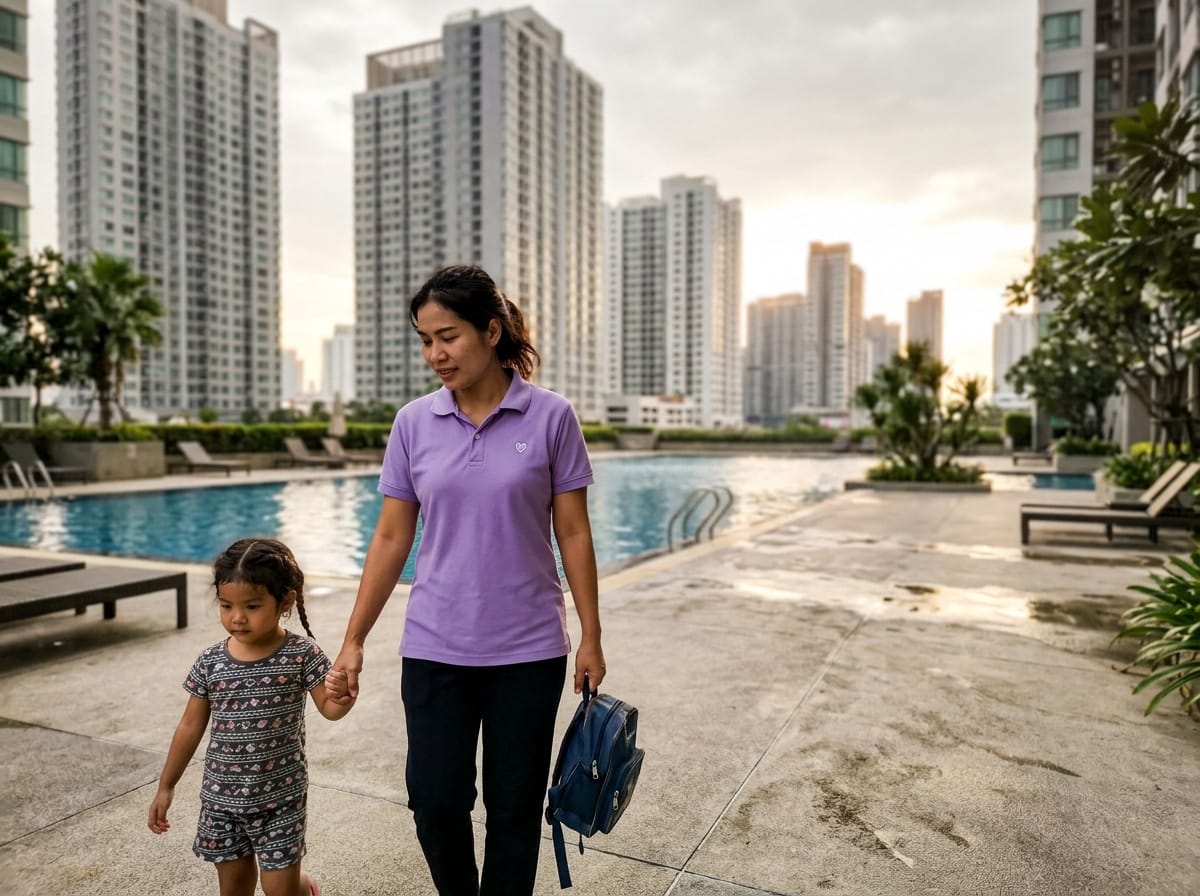
Where the children are cared for, and how homes are set up
There are three common models: one host home, homes rotating weekly, or one home in the morning and the other after lunch. The last tends to fall apart once naps are involved.
Our view: a fixed host home is the most reliable for under-threes. Children nap better in a familiar room and nobody pushes two buggies between buildings at noon. The host family usually gets something back for the use of its home: a lower share of the pay, or the other family covering snacks and supplies.
Safety-check both homes, even the one used less
Walk through both homes with the nanny before the first day. A home that is safe for one toddler is not always safe for two.
- Balcony doors locked or fitted with a high latch, and no furniture near balcony railings.
- Window restrictors on every window a child can reach.
- Cupboard locks on cleaning products and medicines, which are kept high and out of sight.
- Furniture and televisions anchored to the wall.
- Cot or bed for each child that meets current safe-sleep guidance, with nothing loose inside for babies.
- A first-aid kit, the emergency number 1669, both families' addresses in Thai and the nearest hospital on a card by the door.
- A clear rule on the condo pool: the nanny never takes both children into the water alone unless both families have agreed she can and she is a confident swimmer.
Safe Kids Worldwide has room-by-room checklists that work well as a starting point for the walk-through.
Getting between homes in the heat
If the share moves between homes, avoid sunny walks at noon, and check the IQAir Bangkok readings during PM2.5 season, roughly December to March, and keep outings indoors on bad days. If a taxi or car is involved, each child needs a properly fitted car seat, and the agreement should say who supplies them.
What a nanny share costs and how families split it
Sharing does not halve the nanny's work, so it should not halve her pay. A fair share pays the nanny more than a single-family job and still costs each family well under a full private nanny.
CareRova rates for a share
CareRova's full-time live-out nanny rate is ฿29,900 a month all-in, for 5 to 6 days a week. Split evenly, that is ฿14,950 per family before a share premium for the second household, which we quote on request because it depends on the children's ages, the hours and whether care moves between homes. The rate includes vetting, first aid and CPR, monthly check-ins and a 90-day free replacement. See the full table on our pricing page.
For direct hire, full-time nannies in Bangkok typically earn ฿18,000 to ฿40,000 a month. Our nanny cost guide for 2026 explains what moves a rate within that range.
Ways to split the cost
| Split method | How it works | When it is fair |
|---|---|---|
| Even split | Each family pays half of the nanny's pay and agreed extras | Same number of children, same hours, care alternates homes |
| By children | Each family pays in proportion to children cared for, for example two-thirds and one-third | One family brings two children, the other one |
| By hours | Each family pays for the hours its child is in care | One child arrives later or leaves earlier most days |
| Host credit | Even split, minus an agreed monthly credit to the host family | All care happens in one home |
The costs families forget
Agree in writing who pays for the nanny's lunch, taxis, outings, nappies, shared snacks and late-pickup time. Small sums cause big arguments.
If you employ the nanny directly, think about social security too. Employers may register domestic staff with the Social Security Office, and in a share the families need to decide which of them registers her and how the cost is split. With a CareRova placement, we hold the arrangement and handle payroll, so neither family has to.
The written agreement every share needs
A share has three parties: two families and a nanny. Write one agreement that all three sign, in a language the nanny reads comfortably, and give everyone a copy. Our guide to nanny contracts in Thailand covers the employment side clause by clause; this section covers what is particular to a share.
The legal floor is short. Domestic workers are entitled to at least one day off a week, paid public holidays and sick leave, and a foreign nanny needs a valid work permit for the role. The Department of Labour Protection and Welfare is the government body responsible. Everything else below is common practice, and if anything is unusual, have a lawyer check the wording.
| Clause | What to agree | Common sticking point |
|---|---|---|
| Hours and location | Start and finish times, which home on which days | Late pickup by one family making the other's day longer |
| Pay | Total pay, each family's share, pay date, who transfers it | One family paying late; better to pay through one account |
| Holidays | Nanny's annual leave and how both families are told | Families' school holidays not lining up |
| When one family travels | Nanny is still paid in full; travelling family keeps paying its share | A family assuming it pays nothing while away |
| Public holidays | Paid days off for the nanny | Different employers' calendars |
| Sick days | Child sick, nanny sick, who covers and who pays | Covered in the next section |
| House rules | Food, screens, naps, discipline, outings, photos online | Two sets of rules quietly applied to two children |
| Medical consent | Each family's signed consent for first aid and hospital transfer | Missing for the visiting child |
| Notice | How much notice either family or the nanny gives to end the share | Ending with no notice when a child starts school |
One set of house rules
Agree the rules both children live by. If one family allows a cartoon after lunch and the other does not, either both children watch or neither does. Two rulebooks for children sitting side by side is the most draining part of a share for a nanny.
Put allergies at the top of the rules, not the bottom. If one child has a nut allergy, the whole share is nut-free, in both homes, including the other family's packed lunches. The allergy resources from FARE explain why cross-contact from a shared table or an unwashed hand is enough to cause a reaction.
Sick children, sick nanny and two households' rules
This is where most shares are tested. One family wants a feverish child kept at home; the other has a meeting and would rather the nanny cope. Settle it in writing before the first cold.
Rules that work for most shares
| Situation | Share rule | Care for the well child |
|---|---|---|
| Fever of 38 °C or more | Stays home until 24 hours fever-free without fever-reducing medicine | Continues as normal |
| Vomiting or diarrhoea | Stays home until 48 hours after the last episode | Continues; extra cleaning of shared toilet and toys |
| Hand, foot and mouth disease | Stays home until well and blisters have dried, or as both families agree | Continues; watch for symptoms for a week |
| Flu or RSV symptoms | Stays home until fever has gone and symptoms are clearly improving | Continues; extra care if the other child is a young baby |
| Dengue diagnosed | Child is cared for at home by own family under a doctor's advice | Continues; check both homes for standing water |
The 24-hour fever rule follows CDC flu guidance for staying home. The 48-hour rule for stomach bugs matches the NHS advice on food poisoning and diarrhoea, because norovirus spreads easily even after a child seems better.
HFMD needs its own conversation. The CDC describes hand, foot and mouth disease as common and usually mild in under-fives, spread through saliva, blister fluid and stool, and the virus stays in stool for weeks. The NHS HFMD page takes a relaxed view on keeping well children at home, but Bangkok nurseries are often stricter, and in a share the other family's view counts. Agree the line in advance.
For babies, RSV is the one to take seriously. The CDC's RSV page explains why young infants are most at risk. If one family has a baby under six months and the other child has a cough and runny nose, the family with the baby may reasonably ask for separate care until the cough settles.
Who pays on a sick day
The usual practice: the nanny is paid in full whichever child is absent, and a family whose child is off sick still pays its share. It is the only rule that keeps the nanny's income stable.
When the nanny is ill
She is entitled to sick leave. She should stay home with a fever, and after vomiting or diarrhoea until 48 hours after the last episode, especially as she prepares the children's food. On a direct hire, both families need a backup plan, often one parent working from home each day. On a CareRova placement, we arrange cover. Our sick child policy guide has a template you can adapt for two households.
Hygiene across two homes: bottles, toys, food
Two children mean twice the chance of an illness coming in, and in a share things also move between homes.
Hands, on arrival and through the day
Everyone washes hands on arrival in either home, including the parent at drop-off. The nanny washes with soap for at least 20 seconds after each nappy, before preparing food, after wiping noses and after the playground, in line with the CDC's handwashing guidance. Sanitiser is no substitute after nappies.
Bottles, cups and dummies
- Each child has their own labelled bottles, cups, spoons, bowls and dummies. Use different colours if the names wash off.
- Bottles and teats for babies under 12 months are washed in hot soapy water and sterilised after every feed.
- Expressed milk travels in an insulated bag with an ice pack and goes straight into the fridge, labelled with the child's name and the date.
- Nothing that has been in one child's mouth goes near the other's. Dropped dummies are washed, not licked clean.
Food from two kitchens
When each family sends its own food, the nanny becomes responsible for keeping two sets of meals safe. Keep the host fridge at 5 °C or below with a cheap fridge thermometer; the FDA's guide to refrigerator thermometers explains why the dial setting is not enough. Packed food goes into the fridge on arrival, not on the counter. Bacteria grow fastest between about 5 °C and 60 °C, the danger zone described by the USDA, and a Bangkok kitchen sits inside it all day.
Leftovers from a child's plate are thrown away, never saved for the other child. Reheated food is heated until steaming throughout, then cooled to eating temperature. The nanny uses a separate board and knife for raw meat if she cooks, and wipes down the high chairs and table after every meal.
Toys and shared surfaces
Mouthed toys go into a "wash" basket during the day and are washed in hot soapy water each evening. Soft toys and comforters stay with their own child and do not travel. After a sick day, the host home gets a proper clean of toilet, taps, door handles and hard toys; for vomiting bugs that means a bleach-based cleaner, not alcohol wipes. If your housekeeper is stretched, our sister company CleanRova does deep cleans in Bangkok.
Mosquitoes in both homes
In the rainy months, May to October, the nanny checks both homes' balconies once a week for standing water: plant saucers, buckets, drains and toys left outside. The Thai Department of Disease Control runs its dengue messaging around exactly this. Repellent goes on before outdoor play, applied by the nanny with the family's chosen product.
When to end a share, and how to set one up
Most shares end for good reasons: one child starts school, a family moves, or a new baby changes the balance. A share that ends badly usually shows warning signs months earlier.
Signs a share has run its course
- One child needs much more attention than the other, through age, a new sibling or additional needs.
- Hours keep drifting, with one family regularly late at pickup.
- The families disagree on rules and the nanny is caught in the middle.
- The nanny is visibly exhausted or has asked for changes that were not made.
Agree a notice period in the original agreement; one month either way is common practice. Often the remaining family takes the nanny on full-time or part-time, which is worth discussing early. Our guide to live-in versus live-out nannies helps if that change also means reconsidering the arrangement.
Setting up a nanny share: the checklist
- Find the partner family. Same building or soi, children within about a year of each other, compatible hours.
- Have a frank parents' meeting. Sleep, food, screens, discipline, illness, holidays and money. If you cannot agree now, you will not agree later.
- Decide the model. Host home or rotation, and any host credit.
- Choose the nanny together. Interview jointly, and ask about experience caring for two children at once.
- Safety-check both homes with the nanny, using the list above.
- Write and sign the agreement, with all three parties and copies for each.
- Agree the sick rules and allergen rules and pin them to both fridges in Thai and English.
- Trial for two to four weeks, then review together and adjust.
How CareRova helps
We place nannies with experience of caring for two children, run the full checks (police background check, ID and work-eligibility check, at least two references phoned, first aid and CPR) and arrange a paid trial day. We shortlist within 48 hours. With a managed placement we hold the arrangement, run payroll and arrange cover when the nanny is ill, which removes the hardest admin from a three-way relationship. Read more on our nanny service page.
Send us both families' children's ages, your area and buildings, the hours you need, which home you plan to use, any allergies and your start date. WhatsApp or call +66 97 120 3054, email support@carerova.com, or use the contact form.
Frequently asked questions
How does a nanny share work in Bangkok?
Two families employ one nanny together and she looks after both families' children at the same time, usually in one of the two homes. The families split her pay, agree one set of house rules and put the arrangement in writing. Most shares in Bangkok are between neighbours in the same building or soi.
How much does a nanny share cost?
Through CareRova, a full-time live-out nanny is ฿29,900 a month all-in, so an even split is ฿14,950 per family before a share premium for the second household, which we quote on request. Direct-hire nannies in Bangkok typically earn ฿18,000 to ฿40,000 a month, and a fair share pays the nanny more than a single-family job.
What ages work best for a nanny share?
Two toddlers between about 12 months and 3 years, or one toddler and one baby over about 6 months, are the classic pairing. Two young babies on different feeding schedules are close to caring for twins and suit only a very experienced nanny.
Is a nanny share better than daycare in Bangkok?
It gives more one-to-one attention, fewer infections from a large group and care at home, while costing each family less than a private nanny. Daycare offers group play, fixed hours and no employment paperwork. Many families use a share until about age three and then move to nursery.
What happens if one child is sick in a nanny share?
The sick child usually stays in their own home, and the other family decides with the nanny whether care continues for the well child. Agree the rules in writing, including who pays on sick days, before the first illness.
Do we need a contract for a nanny share?
Yes. A written agreement between both families and the nanny should cover hours, location, pay split, holidays, sick days, house rules and notice. Thai rules give domestic workers a weekly day off, paid public holidays and sick leave, and the agreement should reflect that.
Need someone properly vetted?
Get a written rate for your household in under 60 seconds.
Written by the CareRova team
We're Bangkok's vetted home-care agency — everything we write comes from real nanny, chef, housekeeper and senior-care placements across condos, houses and short-stay villas.
Get our Bangkok family-care guides straight in Google — add CareRova as a preferred source.