
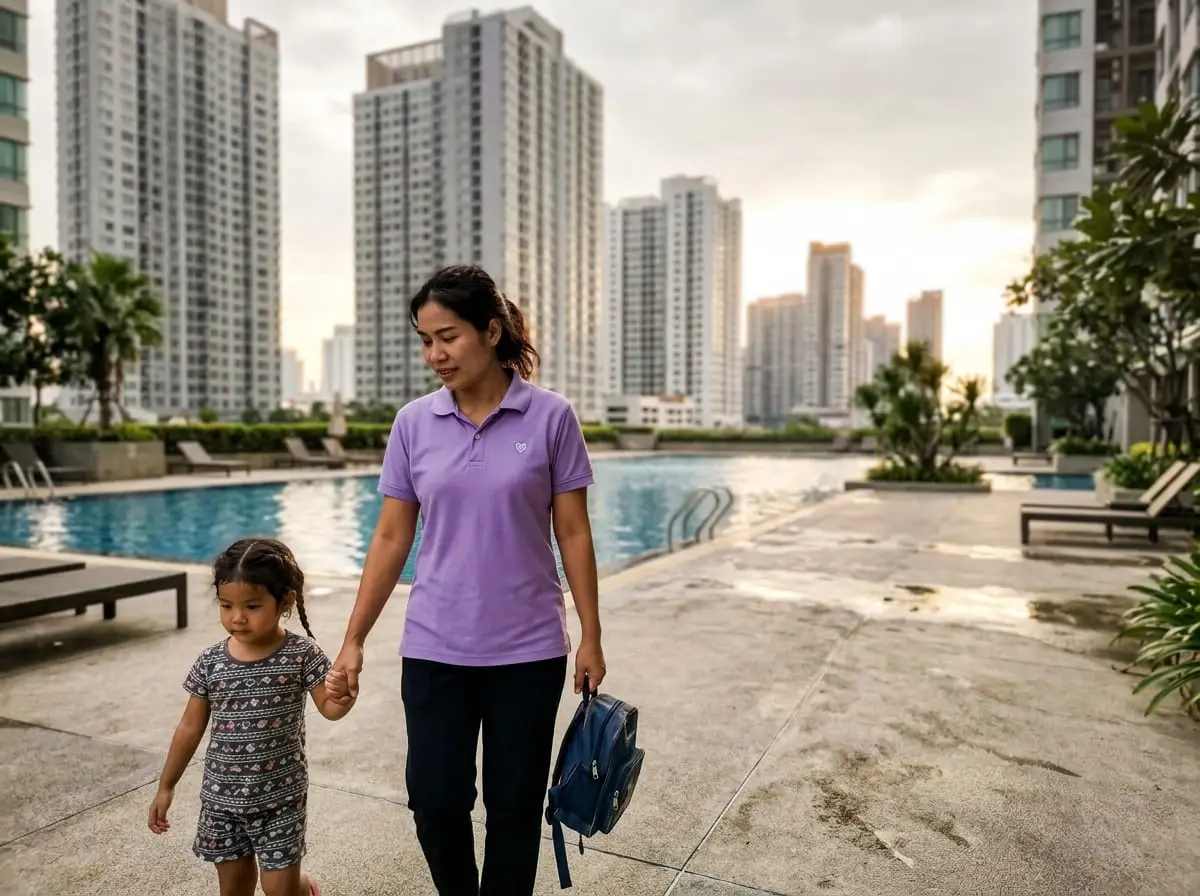
School ends at 15:00. Most working parents get home at 19:00, after an hour on the expressway or a packed BTS. Those four hours are the gap an after-school nanny in Bangkok fills, and they are harder than they look: a tired, hungry child, homework, a swimming lesson across town, dinner, and the slide towards bedtime.
The best after-school nannies are part organiser, part cook, part coach and part homework supervisor. They also need judgement about Bangkok-specific things: when it is too hot to play outside, when the air is too poor, how to keep a seven-year-old's hands clean after a day of shared pencils in HFMD season.
This guide walks through the afternoon from pickup to handover, school collection rules, food, homework and when to bring in a tutor, screen time and activity, heat and PM2.5, after-school hygiene, and what afternoons cost.
What an after-school nanny does from pickup to bedtime
The role is usually 14:30 to 19:30, five hours that cover travel to school, the afternoon itself and a handover when a parent gets home. Some families need 15:00 to 20:00; others want the nanny until bedtime.
A typical afternoon
| Time | What happens | Notes |
|---|---|---|
| 14:30 | Nanny arrives, checks the snack and the day's plan | Snack packed in an insulated bag with an ice pack |
| 14:45 to 15:15 | Travel to school | Allow for traffic and rain |
| 15:15 | Pickup at the agreed gate | Nanny registered with the school office |
| 15:45 | Home, handwashing, snack at the table | Water and a proper snack, not a sweet drink |
| 16:00 to 16:45 | Homework and reading | Quiet place, phone away |
| 16:45 to 17:45 | Activity: swim, park, scooter, board game | Indoors if hot, raining or PM2.5 is high |
| 18:00 | Dinner | Cooked by the nanny, a cook or prepared by parents |
| 18:45 | Bath, uniform for tomorrow, bag packed | School notices checked |
| 19:15 | Reading, quiet time, handover | Short written note for parents |
On activity days, the order changes: pickup, snack in the car, lesson, homework after. The point of the table is that every afternoon has a shape the child can predict, which cuts arguments in half.
What is in the role, and what is not
An after-school nanny looks after the children: travel, food, homework supervision, activities, bath, children's laundry and tidying up after them. She is not a housekeeper, although some families combine the two roles in a longer day and price it accordingly. She is also not a tutor, and the difference is worth understanding before you hire; there is a section on it below.
How the role changes with age
The same five hours look very different at six and at twelve.
- Ages 5 to 7. Hands-on care: holding hands at the gate, bathing, reading aloud, cutting food, close supervision at the pool. Homework is short; routine is everything.
- Ages 8 to 10. More independence, more activities. The nanny becomes a manager of bags, timetables and kit, and the homework block gets longer. She still supervises swimming and road crossings.
- Ages 11 and up. Many children this age resist being "looked after". The role shifts towards transport, a proper meal, a calm place to study and a responsible adult in the home. Agree with your child, and the nanny, what she checks and what she leaves alone.
The first fortnight
Start with a paid trial afternoon, then plan two weeks where a parent is reachable by phone throughout. Walk the school route together once, introduce the nanny to the class teacher or school office, and show her where the first-aid kit, spare uniform and emergency numbers are. Ask for a fuller handover note in the first two weeks; you will both learn what matters and what does not.
Siblings of different ages
Many afternoons involve a toddler at home and an older child at school. That changes the logistics: the toddler either comes on the school run or a second carer stays home. Tell us the ages and the timetable and we will say honestly whether one person can do it safely.
School pickup in Bangkok: traffic, buses and authorisation
Pickup is where the afternoon is won or lost. A nanny who leaves late, waits at the wrong gate or arrives without the right paperwork leaves a child standing outside the office, which no one forgets.
Authorisation
Most international and bilingual schools in Bangkok ask parents to register, in writing, anyone who will collect their child. Before the first day:
- Write to the school office with the nanny's full name and a copy of her ID, and ask what their procedure is.
- Give the nanny a signed authorisation letter to carry, in English and Thai if the school is Thai-medium.
- Tell the school and the nanny about any change on the day, in writing, never by a phone call from a stranger.
- Agree a code word with the child for any unexpected pickup.
Getting there
Bangkok traffic around school gates at 15:00 is predictable in one respect: it is always bad. If the child takes the school bus, the nanny meets the bus at the agreed stop five minutes early. If she collects by car or taxi, she uses a proper car seat or booster for every ride, including ride-hailing cars; Safe Kids Worldwide has clear guidance on which seat suits which age. On the BTS or MRT, she holds younger children's hands on platforms and escalators.
Write one rule into your agreement: children never ride on motorbike taxis. It sounds obvious, but in a downpour with a late lesson, the temptation is real.
When pickup goes wrong
Agree the plan for the three things that eventually happen. If the nanny is running late, she messages you and the school office before the bell, not after, and the school keeps the child inside. If your child is not at the gate, she goes to the office first, then calls you; she does not wander the campus or leave with another family. If the bus does not arrive at the stop, she calls the school's transport desk, whose number should be saved in her phone on day one.
Older children who carry a phone should know they wait in one agreed place and message the nanny, never accept a lift from someone who says they were sent. Write these rules on one page and give a copy to the nanny and to your child.
Choosing a nanny who lives near the route
A nanny who lives on the same BTS or MRT line as the school, or near your home, is far more reliable in rainy season. When CareRova matches afternoon nannies, we look at the route as well as the CV, because a school in Sukhumvit and a home in Bang Na make a very different commute.
Snacks and dinner that are not sugar
Children come out of school hungry, and whatever is handed to them in the first ten minutes sets the tone. The easiest snack in Bangkok, a sweet drink and a bakery bun from the 7-Eleven by the gate, is also the worst.
Snacks that work
Good after-school snacks combine something filling with fruit or vegetables: a cheese and wholemeal sandwich, plain yoghurt with mango, boiled eggs, edamame, steamed corn, rice crackers with hummus, a banana with peanut butter where allowed. The Harvard Nutrition Source and the AAP's HealthyChildren nutrition pages both put water and plain milk forward as everyday drinks and treat sweetened drinks as occasional.
Keeping a packed snack safe until 15:30
A snack packed at 07:00 and eaten at 15:30 has spent eight hours in Bangkok heat. Perishable food is safest out of the fridge for no more than two hours, and the USDA advises no more than one hour above 32 °C, as its danger zone guidance explains. That rules out a ham sandwich in a school bag all day. Either the nanny brings the snack fresh at pickup, in an insulated bag with an ice pack, or the school snack is something shelf-stable: fruit, crackers, unopened UHT plain milk.
Dinner
If the nanny cooks dinner, agree a weekly plan: rice or noodles, a protein, vegetables, and fruit after. She cooks the children's portions before adding fish sauce, chilli or seasoning powder for the adults. Leftovers are cooled and in the fridge within two hours, with the fridge at 5 °C or below; a cheap fridge thermometer tells you whether it is. Raw meat goes on its own board, and hands are washed after handling it.
Allergies at the snack table
If your child has a food allergy, the nanny needs the action plan in writing, the medicines the doctor has prescribed and the training to use them, which you or your doctor should show her. She checks labels on everything, including snacks from friends' parents, and keeps nut-free rules if the school has them. FARE's food allergy resources are a good starting point for families new to an allergy. For younger children's food, our guide on toddler nutrition and lunchboxes goes further.
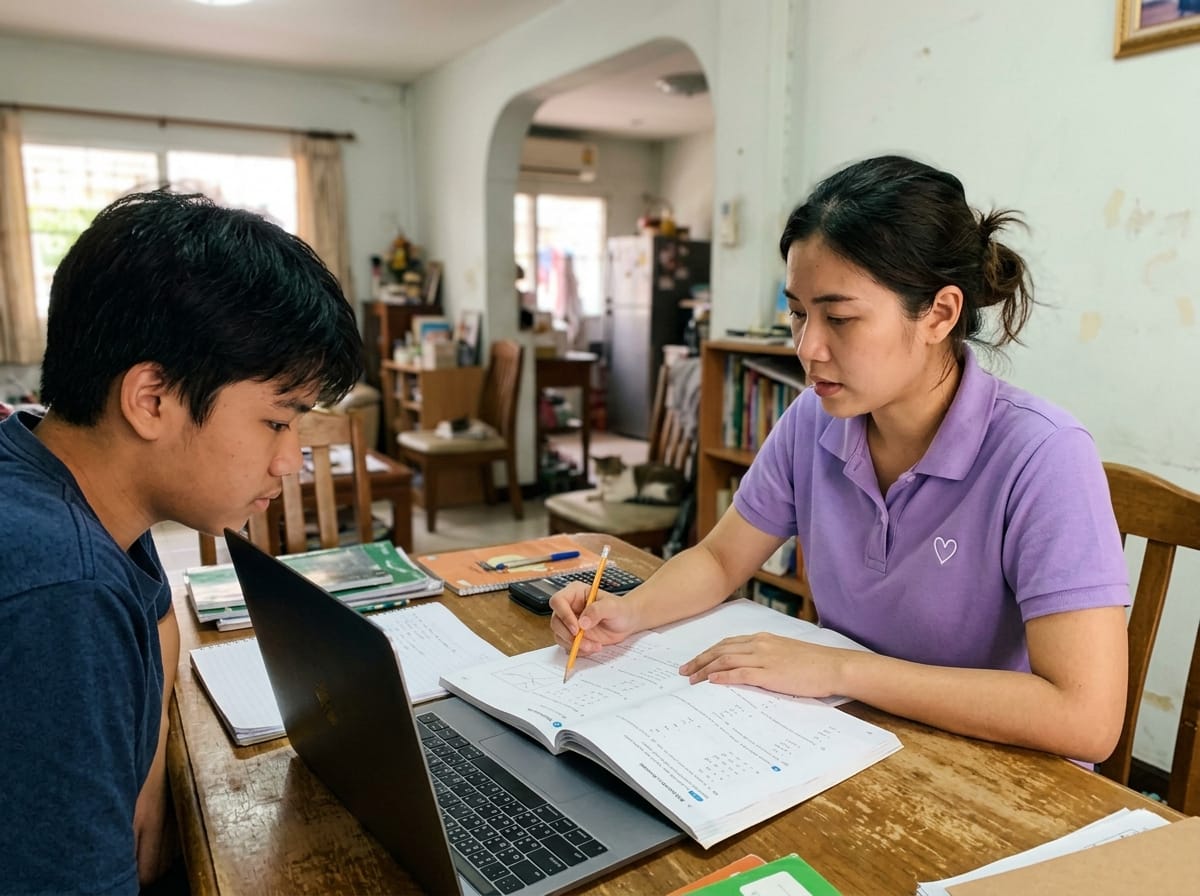
Homework: what a nanny can help with and when to add a tutor
This is where expectations most often go wrong. Parents hope for a nanny who can also teach; nannies are hired for childcare and then asked to explain long division the way the school does it this year.
What a good after-school nanny does
- Sets up a quiet, regular homework spot with the phone and tablet out of reach.
- Checks the planner or school app for what is due.
- Listens to reading every day and signs the reading log if you allow it.
- Practises spelling, times tables and vocabulary with flashcards.
- Keeps the child on task in short blocks, with a break for younger children.
- Notes anything the child found hard, for you to see at handover.
- Helps with Thai-language homework, if she is a Thai speaker and you want it.
What she should not do is the homework itself. Teachers can tell, and the child learns that someone else will always finish it.
When to add a tutor
| Situation | Nanny is enough | Add a tutor |
|---|---|---|
| Daily reading and spelling | Yes | No |
| Times tables and basic maths practice | Yes | Only if the child is falling behind |
| A specific subject gap flagged by the teacher | Supervision only | Yes, one or two sessions a week |
| IGCSE, IB or entrance exam preparation | No | Yes, a subject specialist |
| Learning support needs | Routine and encouragement | Yes, with someone experienced and in contact with the school |
| A second language the family does not speak | Practice if she speaks it | Yes, for structured progress |
Many families keep the nanny for the routine and bring in a tutor at home on one or two afternoons. The nanny then makes sure the child is fed, calm and at the table on time, which matters more to a tutoring session than people expect.
Reading the handover note
Ask for three lines a day: what homework was done, what was hard, anything the teacher sent home. Over a term, those notes show patterns you would otherwise miss, such as a child who always struggles with maths on Thursdays after swimming.
Screen time, play and sport: the evidence-based rules
Afternoons are where screen time creeps in. A tired child, a tired nanny and a tablet within reach is a strong combination.
What the guidance says
The World Health Organization's physical activity guidance recommends that children and adolescents aged 5 to 17 do an average of at least 60 minutes a day of moderate-to-vigorous activity, mostly aerobic, and that recreational screen time is limited. The American Academy of Pediatrics recommends that families set consistent limits for school-age children, so screens do not displace sleep, physical activity or time together, and suggests making a family media plan.
The AAP also endorses sleep recommendations of 9 to 12 hours a night for children aged 6 to 12. A child who goes to bed at 21:00 and gets up at 06:15 for the school bus is already near the bottom of that range, which is one more reason to keep screens out of the last hour before bed.
House rules to give the nanny
- Homework and active play first, screens after.
- A fixed amount on school days, agreed with you, and a timer.
- Screens in shared rooms, not bedrooms.
- No screens at meals or in the hour before bed.
- The nanny does not use her own phone for entertainment while on duty, apart from messages to you and emergencies.
The last rule matters. Children copy what adults do, and a nanny scrolling on the sofa sends a clear message.
Activities that suit Bangkok afternoons
Swimming in the condo pool (always supervised, never left alone at the pool), cycling or scooters in the park, football at a sports club, badminton, dance or martial arts classes. If your child has a weekly class, the nanny handles the bag, the water bottle and the drive. On rainy days, board games, Lego, cooking a simple snack together and drawing all count as good afternoons.
Heat, PM2.5 and outdoor afternoons
Bangkok gives you three reasons to stay indoors in the afternoon: heat, rain and air quality. A good nanny reads all three before going out.
Heat
At 15:00, temperatures are near the day's peak for much of the year. Outdoor play works better from about 16:30, in the shade, with a hat, sunscreen and a full water bottle. Signs of heat exhaustion include heavy sweating, headache, dizziness and unusual tiredness; the nanny moves the child into the shade or indoors, gives water and calls you. A child who is confused, has stopped sweating or is vomiting needs a doctor.
PM2.5 season
From roughly December to March, Bangkok's fine-particle pollution is often at levels that make outdoor play a poor idea. The nanny checks the reading before going out, on IQAir's Bangkok page or the Pollution Control Department, and agrees a cut-off with you. On poor days, play moves to an indoor pool, a play centre or the living room with windows closed and the purifier on. Our guide to a healthy home in PM2.5 season covers purifiers, filters and mould.
Rainy season and dengue
From about May to October, afternoon storms come with mosquitoes. The mosquitoes that carry dengue bite during the day, which puts the after-school hours squarely in the risk window, as the CDC's dengue information explains. The nanny applies repellent as labelled for your child's age before park time, dresses the child in light long sleeves at dusk, and empties any standing water on the balcony.
A quick decision table
| Condition | Outdoor play | Alternative |
|---|---|---|
| Hot but clear, after 16:30 | Yes, shade, water, hat | |
| Peak heat around 15:00 | Short, shaded only | Indoor pool or play inside |
| Thunderstorm or lightning | No | Indoor games, reading, cooking |
| PM2.5 above the agreed cut-off | No | Indoor activity, windows closed |
| Child unwell or recovering | No | Quiet day at home |
After-school hygiene in HFMD and flu season
Children come home from school carrying a day's worth of shared pencils, door handles and coughs. The after-school routine is the family's first line of defence.
The arrival routine
- Shoes off at the door, bag on its hook.
- Hands washed with soap for at least 20 seconds before the snack, following the CDC's handwashing guidance.
- Water bottle and lunchbox emptied, washed in hot soapy water and dried upside down.
- Uniform straight into the wash on days with any illness going around class.
Hand, foot and mouth disease
HFMD is most common in children under five but spreads in primary classes too, through saliva, fluid from blisters and faeces. The NHS page on hand, foot and mouth disease advises keeping children off school while they feel unwell, and handwashing is the main protection at home. If the school sends an HFMD notice, the nanny checks your child's hands, feet and mouth that afternoon, washes towels separately and does not share cups.
Flu and colds
During flu season, the nanny watches for fever, cough and aches at pickup. The CDC's flu information recommends yearly vaccination for most people from six months of age; ask your paediatrician about your child, and ask your nanny whether she is vaccinated.
Sick-day rules
Agree before term starts what happens when your child is ill: who collects from the school nurse, whether the nanny can do a full day, and when your child goes back. The nanny gives no medicine unless you have agreed it in writing, with the dose from the packet or your doctor. Our sick-child policy guide has a full template. If your nanny is ill, she stays home and CareRova arranges cover.
Rates for afternoons and how to book
CareRova guide rates for 2026 are all-in: police background check, ID and work-eligibility check, phoned references, first aid and CPR, a paid trial day and monthly check-ins, with a 90-day free replacement on long-term placements.
| Arrangement | Typical pattern | Guide rate |
|---|---|---|
| Occasional afternoon | 4-hour minimum | ฿450 an hour |
| Part-time nanny | 3 afternoons or days a week | ฿16,900 a month |
| Five afternoons a week | Monday to Friday, around 14:30 to 19:30 | Quoted on request |
| Full day in school holidays | 8 hours | ฿2,900 a day |
| Full-time nanny, live-out | 5 to 6 days, if you also need mornings | ฿29,900 a month |
| Tutor at home | One or two sessions a week | Quoted by subject and level |
An occasional 14:30 to 19:30 afternoon at the hourly rate comes to ฿2,250. For regular afternoons, a monthly arrangement is better value and gives your child the same person every week. School holidays are the other thing to plan: the after-school nanny is the natural person to cover full days, so ask early. Families with a friend in the same building sometimes split an afternoon nanny; our guide to nanny shares in Bangkok explains how. The full table is on our pricing page.
What to send us
- Children's ages and school, with the finish time each day.
- Days and hours needed, including activities and where they are.
- Whether the nanny cooks dinner, and any allergies or dietary rules.
- Homework expectations, and whether you want a tutor as well.
- Your area and how the nanny will travel to school.
See our nanny service for how placements work. To get a shortlist within 48 hours, WhatsApp or call +66 97 120 3054, email support@carerova.com, or use the contact form.
Frequently asked questions
How much does an after-school nanny cost in Bangkok?
With CareRova, a part-time nanny for three days a week is ฿16,900 a month all-in. Five afternoons a week is quoted on request because hours vary by school timetable. Occasional afternoons are ฿450 an hour with a 4-hour minimum.
Can an after-school nanny help with homework?
Yes, within limits. A good nanny supervises homework, listens to reading, practises spelling and times tables and keeps the child organised. She should not do the work for the child, and for a specific subject gap or exam preparation a qualified tutor is the better choice.
Can the nanny pick my child up from an international school?
Yes, once the school has your written authorisation. Most schools ask parents to register anyone who will collect a child; give the school office the nanny's name and photo ID details and tell them about any change in advance.
How much screen time should my child have after school?
The AAP recommends that families set consistent limits for school-age children so screens do not displace sleep, physical activity and homework. A simple rule is homework and active play first, then an agreed amount of screen time, with no screens in the hour before bed.
Should my child play outside in the afternoon in Bangkok?
Yes, on most days, but timed for the heat and the air. Late afternoon is usually cooler than 15:00. During PM2.5 season, roughly December to March, the nanny checks the air quality reading before going out and moves play indoors on poor days.
Can I combine a nanny and a tutor?
Yes. Many families keep the nanny for pickup, food and routine and add a tutor for one or two sessions a week at home. CareRova places both, and tutor sessions are quoted on request depending on the subject and level.
Need someone properly vetted?
Get a written rate for your household in under 60 seconds.
Written by the CareRova team
We're Bangkok's vetted home-care agency — everything we write comes from real nanny, chef, housekeeper and senior-care placements across condos, houses and short-stay villas.
Get our Bangkok family-care guides straight in Google — add CareRova as a preferred source.