
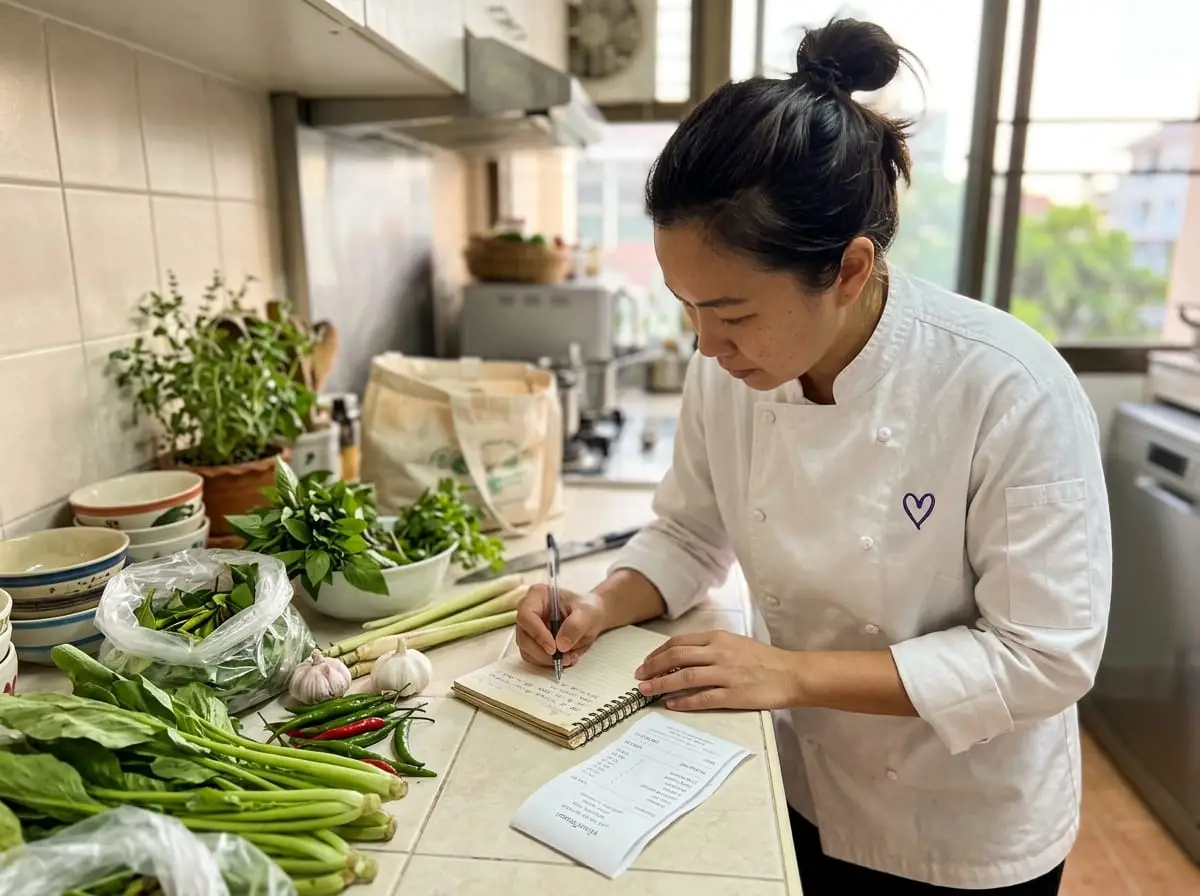
Korean food has gone from niche to everyday in Bangkok. Korean families posted here for work want the stews and side dishes they grew up with, and plenty of Thai and expat households now order Korean fried chicken and tteokbokki more often than pad thai. A Korean private chef in Bangkok serves both groups: someone who cooks real home food in your kitchen rather than the restaurant version.
Real Korean home cooking is quieter than the barbecue restaurants suggest: rice, a pot of stew, and a fridge of small side dishes that last for days. That structure suits a part-time chef very well.
This guide covers the banchan system, a week of meals with children's versions, Korean BBQ in a condo, kimchi safety at 30 °C, salt and sugar, sourcing and costs.
Who hires a Korean private chef in Bangkok
Most requests we see come from three kinds of household.
Korean families on a posting. Parents working for Korean companies, children at international or Korean schools, and a clear picture of what dinner should taste like. The brief is usually specific: doenjang jjigae the way it is made at home, banchan topped up twice a week, and gimbap lunchboxes the children will actually open.
Thai and mixed families who love K-food. Teenagers raised on K-dramas and parents who like Korean flavours but not the delivery bill or the oil.
Hosts. A Korean BBQ night for friends, a birthday dinner, or a villa group that wants a change from Thai seafood.
Geography follows the community. Many Korean households live along Sukhumvit, where Sukhumvit Plaza on Soi 12 is known as Korea Town, and in Thonglor and Ekkamai, where the Japanese and Korean grocery shelves are deepest.
Who the cook usually is
In Bangkok, a cook who does Korean food well is often a Thai cook who learned in Korean restaurants or spent years with a Korean employer. Korean-national cooks exist, and any foreign national cooking in your home needs a valid work permit for the role. Passport matters less than three skills you can test on a trial day: a proper anchovy and kelp stock, correctly salted cabbage, and seasoning adjusted to your family rather than to a restaurant menu.
Every chef CareRova places holds food-hygiene certification, has passed a police background check and has had at least two references phoned. The trial day tells you the rest.
The banchan system: why Korean home cooking suits meal prep
A Korean home meal has three parts: bap (rice), guk or jjigae (soup or stew), and banchan, the small side dishes that fill the table. A family might have four or five banchan at dinner, and most of them are made in batches and kept in the fridge for days.
For a part-time chef that is ideal. On cooking day one the chef makes stock, five or six banchan and a stew; on cooking day two they top up whatever ran out and cook a fresh main. On the days in between, the family heats the stew, cooks rice and opens the fridge.
| Banchan | What it is | Fridge life at 5 °C or below | Good for children? |
|---|---|---|---|
| Kongnamul muchim | Blanched soybean sprouts with sesame oil and garlic | 2–3 days | Yes, without chilli flakes |
| Sigeumchi namul | Blanched spinach with sesame and soy | 2–3 days | Yes |
| Gamja jorim | Soy-braised potato cubes | 3–4 days | A reliable favourite |
| Jangjorim | Soy-braised beef or quail eggs | 3–4 days | Yes, made with less soy |
| Myeolchi bokkeum | Stir-fried dried anchovies | 3–4 days (labelled) | Crunchy and popular, but salty |
| Oi muchim | Quick cucumber salad | Same day | Yes, without chilli |
| Gyeran-mari | Rolled omelette | Same day | Yes |
| Baechu kimchi | Fermented napa cabbage | Weeks, getting sourer | White kimchi (baek kimchi) for young children |
We work to the USDA's guidance on leftovers and food safety: cooked food cooled and refrigerated within two hours, and eaten within three to four days. Dry, salty banchan like anchovies often last longer in practice, but a dated label means nobody has to guess.
How the chef handles a banchan batch
- Sprouts and spinach are blanched, refreshed in cold water and squeezed dry, then dressed. Never serve raw bean sprouts to young children; blanching is part of the dish anyway.
- Braises are cooled in shallow containers before they go into the fridge, not left in the pot on the hob.
- Every container gets a label: dish, date made, eat-by day, and allergens such as sesame, soy, wheat, fish or shellfish.
- Serving is done with clean chopsticks or a spoon from the container to a small dish. Nobody eats out of the main box, which is how banchan spoil early.
Our guide to weekly meal prep and fridge safety covers labelling and the fridge map in more detail.
A week of family meals with children's versions
Here is a realistic three-day-a-week part-time schedule for a family of four with children aged five and nine. The chef cooks on Monday, Wednesday and Friday; Tuesday and Thursday run on leftovers and banchan.
| Day | Family dinner | Children's version | Next-day lunchbox |
|---|---|---|---|
| Monday (cook day) | Doenjang jjigae with tofu and courgette, grilled mackerel, rice, five banchan | Stew made with less paste; mackerel deboned and flaked | Gimbap with egg, carrot, spinach and ham |
| Tuesday | Reheated stew, banchan, fresh rice | Gyeran-mari made by the parents or the nanny | Rice, jangjorim and cucumber |
| Wednesday (cook day) | Beef bulgogi with lettuce wraps, japchae, banchan top-up | Bulgogi with less sugar, no chilli; extra japchae | Bulgogi rice bowl |
| Thursday | Japchae and bulgogi leftovers, miyeok-guk seaweed soup | Same, soup made mild | Jumeokbap rice balls with tuna and seaweed |
| Friday (cook day) | Kimchi jjigae with pork and tofu, bibimbap night | Build-your-own bibimbap with a fully cooked fried egg, sesame oil and soy instead of gochujang | Weekend off |
The children's rule: heat goes in last
Korean heat comes from two things: gochugaru (chilli flakes) and gochujang (fermented chilli paste). The chef cooks the base, takes the children's portion out, and then adds the chilli to the adult pot or serves gochujang on the side. Two classic swaps make it easy:
- Gungjung tteokbokki, the royal court style of rice cakes, braised with soy, beef and vegetables instead of chilli sauce.
- Baek kimchi, white kimchi made without chilli flakes, which many Korean children eat before they move on to the red kind.
Rice cakes are dense and chewy. For under-fives, the chef should slice them thinly; the American Academy of Pediatrics' home safety advice treats sticky, round and firm foods as choking risks for small children.
Allergens hidden in a Korean kitchen
Korean cooking uses a handful of allergens almost everywhere, and the chef's allergen list should name them:
- Sesame: sesame oil and toasted seeds in nearly every namul.
- Soy and wheat: soy sauce, doenjang and many gochujang brands contain wheat.
- Fish and shellfish: anchovy stock, fish sauce and saeujeot (salted shrimp) in most kimchi.
- Egg: gyeran-mari, gimbap, bibimbap, and the batter on jeon pancakes.
FARE's food allergy resources and the UK Food Standards Agency's allergy and intolerance guidance explain how cross-contact happens through shared oil, boards and spoons. For a shellfish-allergic child, the chef makes kimchi without salted shrimp and keeps it in its own labelled jar.
Korean BBQ at home: grills, smoke, condos and raw-meat safety
Korean BBQ is the party dish everyone wants and the one most likely to go wrong in a condo: smoke, carbon monoxide, burns at a crowded table and raw meat travelling to cooked plates.
Choosing the grill
| Grill type | Where it works | The catch |
|---|---|---|
| Electric or induction grill plate | Any condo kitchen or dining table | Less smoky flavour; needs a fat channel and a tray |
| Butane tabletop stove with a grill pan | Well-ventilated room or open terrace | Canisters must be stored cool and changed outdoors; never cover the stove with an oversized pan |
| Charcoal tabletop grill | Open garden or house terrace only | Carbon monoxide indoors; often banned by condo rules; adds to smoke in PM2.5 season |
| Oven or griddle pan | Rainy nights and bad-air days | Not table-side, but the meat is just as good |
Charcoal produces carbon monoxide, which is odourless. The US EPA's indoor air quality guidance lists unvented combustion as a leading indoor source, and an enclosed balcony counts as indoors. Between roughly December and March, Bangkok's PM2.5 readings are often already poor; check IQAir's Bangkok readings before planning any outdoor grill and move to the induction plate on bad days. Ask your juristic office about grill rules before the guests arrive.
Smoke without the alarm
Pork belly (samgyeopsal) throws fat. The chef trims the thickest fat, uses a plate with a drain, runs the cooker hood at full speed and keeps the grill away from the smoke detector. Sugary marinades burn fast, so galbi and bulgogi need lower heat and frequent turning.
Raw meat at the table
Table-side grilling breaks the usual separation between raw and cooked food, so the chef has to build it back in:
- Two pairs of tongs. Raw tongs only ever touch raw meat. Cooked meat comes off the grill with a second, clean pair.
- Two pairs of scissors. Korean BBQ is cut with scissors on the grill. Raw cuts and cooked cuts each get their own pair, or the scissors are washed between uses.
- Small raw platters. Raw meat comes out of the fridge one platter at a time. The USDA's danger zone guidance gives one hour as the limit above 32 °C, and a crowded room with a hot grill gets there fast.
- No reused marinade. Marinade that touched raw meat is discarded, or boiled hard before it goes anywhere near a plate.
- Proper temperatures. Chicken (dak galbi) to 74 °C, minced meat such as tteokgalbi patties to 71 °C, and whole cuts of pork and beef to at least 63 °C, per the FoodSafety.gov temperature chart. Thin slices cook through in a minute; thick galbi needs a probe.
Children at the grill
The grill sits in the middle of the table, at a child's chest height. Seat young children at the far end, serve their meat cut small from the cooked plate, and keep the butane canister and spare grill plate out of reach. A trained adult, chef or nanny, should be the only person turning the meat.
Kimchi, fermentation and food safety in Bangkok heat
Kimchi is safe because salt and the acid made by lactic acid bacteria keep harmful bacteria in check. That depends on clean handling and temperature, and a 30 °C room speeds everything up.
Making kimchi in a Bangkok kitchen
- Hands and gloves. Hands washed for at least 20 seconds before starting, as the CDC's handwashing guidance sets out, then food-safe gloves for mixing the chilli paste into the cabbage. The gloves protect the cook's skin as well as the kimchi.
- Clean jars. Washed in hot soapy water, rinsed and dried, or scalded with boiling water. A jar that smelled of last month's batch is not clean.
- Proper salting. The cabbage is salted until it bends without snapping, then rinsed and drained well. Under-salted kimchi goes soft and spoils.
- Pressed under brine. The vegetables are packed down so liquid covers them, with headspace left for gas. The lid is opened briefly once a day while it ferments.
- A short start. In Korea, kimchi may sit out for a day or two. In Bangkok, a few hours to one day at room temperature is usually enough before it moves to the fridge.
- Fridge at 5 °C or below. The US FDA's refrigerator thermometer guidance is the reason to keep a cheap thermometer on the shelf; many condo fridges run warmer than their dial suggests.
- Clean utensils every time. Kimchi comes out with clean tongs or chopsticks, never ones that have been in someone's mouth.
When to throw it out
Sour is fine; older kimchi is perfect for jjigae. Fuzzy mould, a slimy texture, a rotten rather than sour smell, or a lid bulging hard are reasons to discard the whole jar. When in doubt, it goes.
The cook's health matters more with raw food
Kimchi is never cooked once it is mixed, so whatever is on the cook's hands goes straight into the jar. Norovirus has caused outbreaks linked to kimchi in Korea. The CDC's norovirus guidance says people who have been sick should not prepare food for others for at least two days after symptoms stop. CareRova chefs follow that rule for every dish; kimchi day is where it matters most.
The raw dishes we leave out of family kitchens
| Dish | Why it stays out | Safer alternative |
|---|---|---|
| Yukhoe (raw seasoned beef) | Raw beef carries E. coli and Salmonella risks | Bulgogi cooked through |
| Ganjang gejang and yangnyeom gejang (raw marinated crab) | Raw shellfish; serious risk for children, pregnancy and older relatives | Steamed crab or cooked crab jjigae |
| Gul kimchi (fresh kimchi with raw oysters) | Raw oysters can carry norovirus and hepatitis A | Kimchi without oysters; oysters cooked in a pancake |
| Raw egg yolk on bibimbap | Salmonella risk for small children | A fully cooked fried egg |
The WHO's hepatitis A fact sheet lists contaminated food and raw shellfish among the routes of infection. Adults can order raw crab at a restaurant if they choose; a family chef should not serve it at home.
Sodium, sugar and the healthy version of Korean comfort food
Korean home food is full of vegetables, tofu, seaweed, fish and rice, and much of it is steamed, blanched or simmered. The weak point is salt. Kimchi, doenjang, gochujang, soy sauce and salted shrimp all carry heavy sodium, and a meal can include four of them. Harvard's Nutrition Source explains why sodium matters for blood pressure even in people who feel fine.
Practical ways a chef cuts salt
- Make stock from scratch. Anchovy and kelp stock tastes better than beef stock powder, which carries a large dose of salt.
- Reduced-salt soy and less paste. A good cook builds flavour from garlic, spring onion, sesame and stock, and uses less doenjang or gochujang to finish.
- Smaller stew bowls. Jjigae is a shared dish eaten with rice. Serve it in a small bowl and eat more of the solids than the broth.
- Fresher kimchi for the table. Young kimchi is milder, and children's portions can be rinsed.
- No salt for babies. NHS weaning and feeding guidance is clear that babies should not have salt added to their food, so a baby's portion is taken out before any seasoning.
Sugar and frying
Sugar hides in bulgogi marinade, braises, tteokbokki sauce and Korean fried chicken glaze. The traditional fix is the best one: grated Asian pear and onion tenderise and sweeten bulgogi, so the chef needs far less sugar. Fried chicken can be oven-baked or air-fried with a light glaze for weeknights and saved as a proper fried treat for the weekend.
Rice
Many Korean families eat japgokbap, white rice cooked with barley, black rice, beans or millet. It is a traditional habit and an easy way to get whole grains into children. Harvard's guidance on whole grains supports exactly this kind of swap. Families following a doctor's plan for weight, blood sugar or blood pressure should read our guide to a healthy meal chef for weight loss and diabetes, and agree any changes with their own doctor.
Sourcing: Korea Town grocers vs supermarkets
| Ingredient | Korea Town marts (Sukhumvit Plaza, Soi 12) | Thai markets and supermarkets | Notes |
|---|---|---|---|
| Gochugaru, gochujang, doenjang | Widest range, Korean brands | Big brands in larger supermarkets | Check the Thai label and registration number on imports |
| Napa cabbage, spring onion, garlic | Available | Cheaper and fresher at Thai markets | Buy cabbage on kimchi day |
| Korean radish (mu) | Sometimes | Thai white radish works for most dishes | Texture is slightly softer |
| Thin-sliced pork belly, galbi cuts | Korean butchers cut to order | Shabu slices in supermarkets | Keep chilled; buy last |
| Dried anchovies, kelp, seaweed | Best quality | Some supermarkets | Store dry and sealed against humidity |
| Tofu, eggs, everyday vegetables | Limited | Thai supermarkets and markets | No reason to pay import prices |
| Short-grain rice, mixed grains | Korean bags | Japanese-style rice in supermarkets | Store in a sealed container |
Labels and the cold chain
Imported pastes, chilli flakes and sauces sold legally in Thailand should carry a Thai label with a registration number from the Thai Food and Drug Administration. That is a sensible minimum for anything your children eat every day.
Korea Town is a short BTS ride from most of Sukhumvit, but meat still has to make the trip. The chef carries an insulated bag with ice packs, buys meat and seafood last, and has it in the fridge within the hour. Dried goods such as anchovies, kelp and gochugaru go into airtight containers: in Bangkok's humidity, an open bag of chilli flakes clumps and can grow mould within weeks.
Grocery money
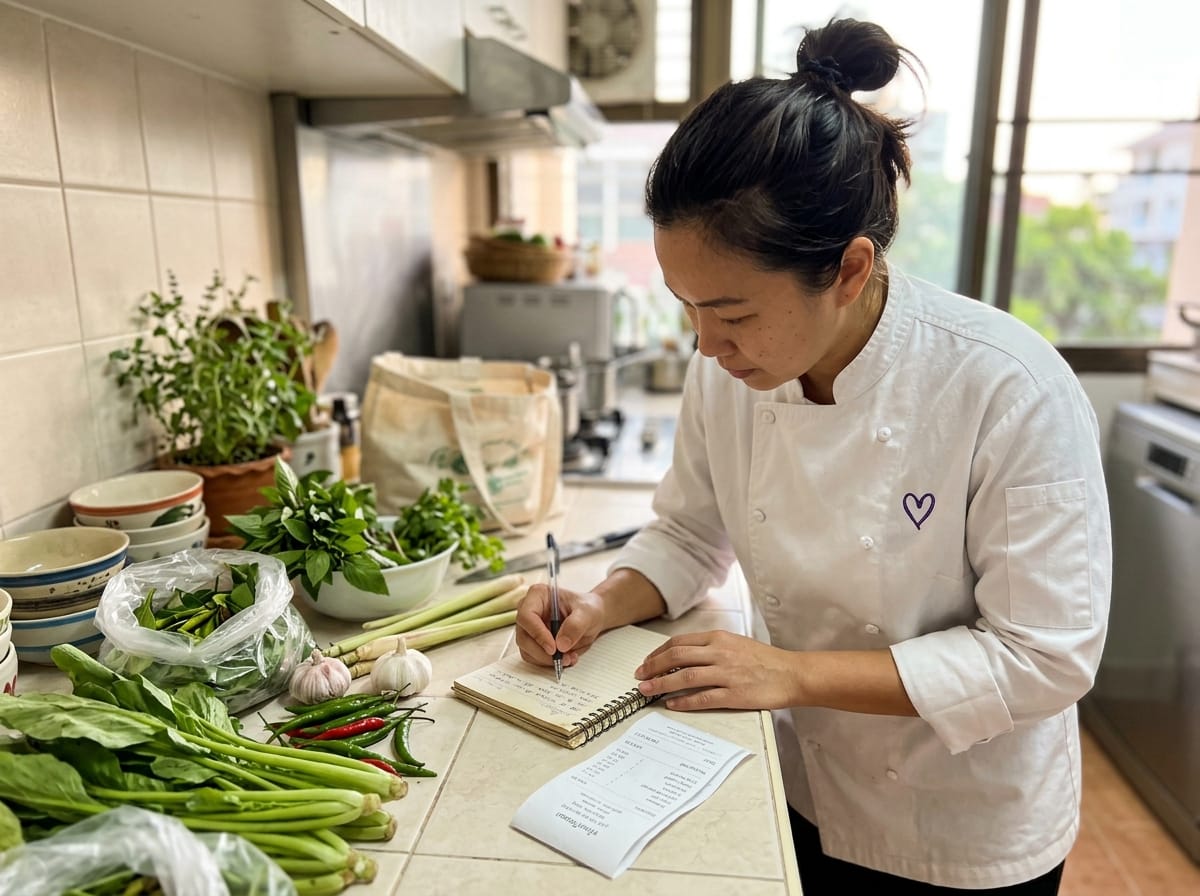
Expect a one-off pantry shop in the first week for pastes, sesame oil, chilli flakes and dried goods; after that, the weekly bill depends mostly on how much beef you eat. Receipts are photographed, market purchases are logged, and a good chef never marks up groceries.
Rates and how to book
CareRova's guide rates for a private chef or home cook are all-in: vetting, payroll, sick cover and, on long-term placements, a 90-day free replacement.
| Format | What it covers | Guide rate |
|---|---|---|
| Hourly, four-hour minimum | A Korean BBQ evening or a one-off kimchi day | ฿900 an hour |
| Daily, eight hours | A trial day or a big banchan and kimchi batch | ฿4,900 |
| Part-time, three days a week | Banchan, stews and mains on cook days, lunchboxes | ฿19,900 a month |
| Full-time live-out, five to six days | All meals, shopping and kitchen management | ฿34,900 a month |
| Live-in, six days | As full-time, with a room and meals provided | ฿31,900 a month |
| StayCare in-villa chef dinner | Korean BBQ or dinner for up to 6 guests | ฿5,900, ingredients extra |
Groceries are never included; they go on your account or are reimbursed at cost. For a dinner party above six guests we quote on request. For comparison, a home cook hired directly in Bangkok costs ฿18,000–35,000 a month and a trained private chef ฿30,000–60,000. Our private chef cost guide explains each format, and the full table is on the pricing page.
What to send us
- Household size, children's ages and anyone older or pregnant at the table
- Which Korean dishes you want most, and whether a family member grew up eating them
- How many cook days a week, and whether you want lunchboxes
- Allergies in writing, especially sesame, wheat, fish and shellfish
- Your kitchen: induction or gas, oven, fridge size, and whether the building allows table-top grills
- Your area and the date you would like a trial day
CareRova comes back with a shortlist within 48 hours. Read more about the private chef service, then message us on WhatsApp at +66 97 120 3054 or use the contact form to book a Korean trial day.
Frequently asked questions
How much does a Korean private chef cost in Bangkok?
CareRova's all-in guide rates are ฿900 an hour with a four-hour minimum, ฿4,900 a day, ฿19,900 a month part-time and ฿34,900 a month full-time live-out. Groceries are extra and bought on your account or reimbursed at cost.
Can a Korean private chef make kimchi at home in Bangkok?
Yes, and a good one will. The cabbage needs proper salting, a clean jar, gloves, a short fermentation start at room temperature and then the fridge at 5 °C or below. Kimchi sours much faster in Bangkok heat than in Korea, so most cooks make smaller batches more often.
Is Korean BBQ at home safe in a condo?
It is with an electric or induction grill plate, the cooker hood on and the windows managed for smoke. Never use charcoal indoors or on an enclosed balcony, check your building's rules, and keep raw-meat tongs and scissors separate from the ones used for cooked meat.
What Korean food is good for children?
Steamed egg, rolled omelette, mild bulgogi, japchae, gimbap, soy-braised potatoes, soybean sprout salad and soy-based tteokbokki are all child-friendly. The chef takes the children's portion out before adding gochujang or chilli flakes.
Where does a Korean chef buy ingredients in Bangkok?
Usually Korean marts around Sukhumvit Plaza on Sukhumvit Soi 12 for pastes, chilli flakes, seaweed and Korean cuts, plus Thai markets and supermarkets for napa cabbage, tofu, vegetables and everyday meat.
Do we need a Korean national as our chef?
No. What matters is that the cook can make proper stock, salt cabbage correctly and cook to your family's taste, which a trial day shows. A foreign national cooking in your home needs a valid work permit for the role.
Need someone properly vetted?
Get a written rate for your household in under 60 seconds.
Written by the CareRova team
We're Bangkok's vetted home-care agency — everything we write comes from real nanny, chef, housekeeper and senior-care placements across condos, houses and short-stay villas.
Get our Bangkok family-care guides straight in Google — add CareRova as a preferred source.