

Hiring a night nanny in Bangkok is usually decided at 4 am, about three weeks in, when the newborn haze has turned into something closer to survival. One good night's sleep does not fix everything, but it changes how you cope with the day, how you recover from the birth and how you feel about your baby.
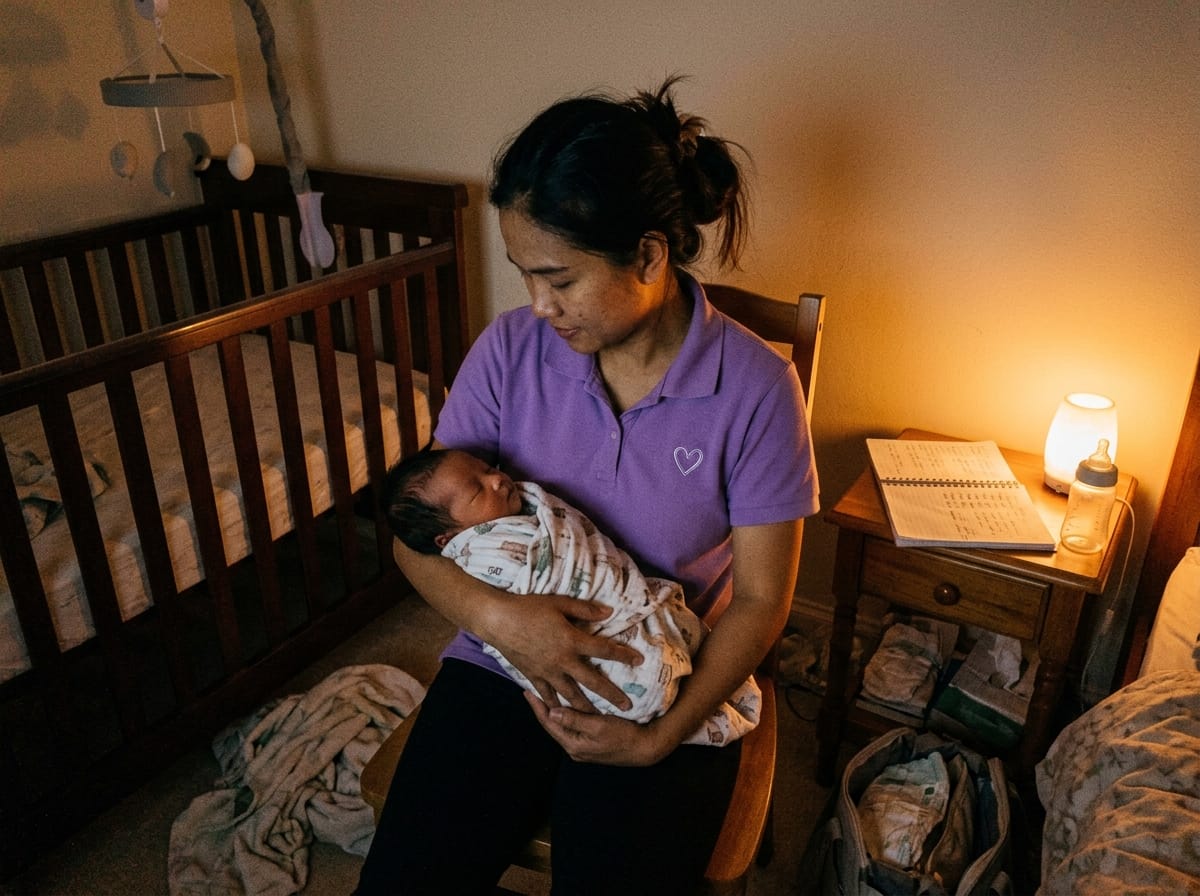
A night nanny is not a luxury version of a babysitter. She is a specialist who works through the night so you do not have to: feeding or bringing the baby for feeds, settling, changing, washing bottles and writing down everything, so that by morning you know exactly how the night went.
This guide explains what the shift looks like, how to make the bedroom safe in a Bangkok climate, the log that makes nights shorter, gentle sleep shaping by age, twins and reflux, night-time hygiene, your own sleep and mood, and what it costs.
What a night nanny does between 9 pm and 7 am
A typical shift starts at 21:00 and ends at 07:00. Some families prefer 22:00 to 06:00; ten hours is the most common.
The shift, hour by hour
| Time | What happens | Who is involved |
|---|---|---|
| 20:45 | Nanny arrives, washes hands, reads the day log | Nanny and parent |
| 21:00 | Handover: last feed time, nappies, any concerns, plan for the night | Nanny and parent |
| 21:30 to 23:00 | Bedtime feed, settle in the cot, prepare bottles and pump parts | Nanny (mother if breastfeeding) |
| 23:00 to 06:00 | Feeds on cue, nappy changes, winding, resettling; log every event | Nanny; mother woken for breastfeeds as agreed |
| Between feeds | Washes and sterilises bottles, folds baby laundry, restocks the changing station | Nanny |
| 06:00 to 06:45 | Morning feed, nappy, fresh clothes | Nanny |
| 06:45 to 07:00 | Written and verbal handover; log left on the kitchen counter | Nanny and parent |
What is in the role, and what is not
The night nanny does everything for the baby: feeds, nappies, settling, bathing if agreed, baby laundry, bottles, pump parts and the log. She does not clean the house, cook for the family or look after older siblings unless that has been agreed and priced. She stays awake and alert; a nanny sleeping in the next room while a monitor runs is a different and cheaper arrangement, and it should be described honestly.
Breastfeeding, bottles and mixed feeding
If you are breastfeeding, the nanny brings the baby to you when the baby wakes to feed, takes the baby back for winding and nappy, and resettles. Many mothers choose to have one feed in the night given as expressed milk by bottle so they get a single long stretch of sleep. Your midwife or a lactation consultant can advise on how to protect your supply while you do that.
The first night with a new nanny
Stay up for the first handover and walk the nanny through the nursery: where the spare sheets, nappies, thermometer and bottles are, how the steriliser works, which aircon remote controls which room and how you want to be woken. Agree the wake-up rules in writing, then go to bed. Most parents sleep badly the first night out of habit; by the third, they sleep.
For formula or mixed feeding, the nanny prepares each feed fresh and records amounts. The WHO's guidance on infant and young child feeding supports breastfeeding where possible; the job of a night nanny is to support whatever plan you have chosen, not to impose one.
Safe sleep in a Bangkok bedroom: cot, aircon, nets
The most important part of a night nanny's job is the one you never see: putting the baby down safely every time, at 3 am as carefully as at 9 pm. The American Academy of Pediatrics' safe-sleep recommendations, summarised on the AAP's HealthyChildren baby sleep pages, are the standard we ask every nanny to follow.
The core rules
- Back to sleep, every sleep. Naps and nights, until the baby's first birthday.
- Firm, flat surface. A cot or bassinet with a firm mattress and a fitted sheet. No inclined sleepers, car seats or bouncers for routine sleep.
- Nothing else in the cot. No pillows, bumpers, loose blankets, soft toys or positioners.
- Room-share, do not bed-share. The cot in the parents' room for at least the first six months is recommended. A nanny never sleeps with the baby on a sofa, armchair or bed.
- Avoid overheating. Light layers, no hats indoors, nothing over the face.
- Smoke-free. No smoking in the home or near the baby.
Aircon and temperature
There is no single official room temperature, but the AAP is clear that overheating is a risk. In Bangkok, where it is 28 °C or more outside at midnight for much of the year, most families run the aircon at a comfortable room temperature and adjust the baby's clothing instead of adding blankets. A cotton bodysuit and a light sleeping bag sized for the baby is usually enough.
The nanny checks the baby's chest or the back of the neck, not the hands or feet, which are often cool. Sweaty hair or a flushed face means remove a layer. She also keeps the aircon from blowing directly onto the cot and makes sure the unit has been cleaned recently, because a mouldy filter in a closed bedroom is the last thing a newborn needs.
Mosquitoes and dengue
During the rainy months, roughly May to October, dengue risk rises in Bangkok. The CDC's dengue guidance recommends mosquito netting over cribs and strollers for babies too young for repellent. The safest set-up is window and door screens first, then a purpose-made cot net that fits tightly, sits outside the cot and is tucked away from the baby's reach, with no loose fabric or cords inside.
The nanny empties any standing water on the balcony during the day, keeps the bedroom door shut, and checks inside the net before each sleep. The Sleep Foundation's baby sleep section also has practical advice on keeping the sleep space clear and calm.
The feeding and sleep log that makes nights shorter
A good log is the difference between "she was up a lot" and "she fed at 23:10, 02:20 and 05:15, took 90, 100 and 110 ml, and settled within ten minutes after the second feed but needed thirty after the third". The second version tells you what to change.
What the nanny records
| Column | Example entry | Why it matters |
|---|---|---|
| Time awake | 02:20 | Shows the length of each stretch |
| Feed | Breast, left 12 min, right 8 min; or bottle 100 ml expressed | Tracks intake and which feeds could change |
| Wind and settling | Burped twice, settled in cot at 02:55 | Shows what works for this baby |
| Nappy | Wet; dirty (colour, consistency) | Hydration and digestion |
| Time asleep | 03:00 | Calculates sleep totals |
| Notes | Hiccups, spat up a little, stuffy nose | Flags patterns for the paediatrician |
Wet and dirty nappies are a simple, useful sign that a young baby is getting enough. If the count drops, or a baby is unusually sleepy and hard to wake for feeds, the nanny tells you at once rather than writing it down for the morning.
When the nanny wakes you, whatever the hour
Some things never wait for the morning handover. Agree in advance that the nanny wakes you, and calls 1669 or takes the baby to hospital if needed, for any of these:
- A temperature of 38 °C or higher in a baby under three months.
- Breathing that looks fast, noisy, laboured or has pauses, or lips or face turning blue or grey.
- A baby who is floppy, unusually drowsy or very hard to wake for feeds.
- Refusing several feeds in a row, or far fewer wet nappies than usual.
- Green or bloody vomit, or a rash that does not fade when pressed.
These are general warning signs, not a diagnosis, and your paediatrician may give you a more specific list for your baby. Write it on the emergency card.
Reading the log after a week
After about seven nights, patterns appear. A baby who always wakes about 40 minutes after going down may need more winding. A baby who feeds every two hours until 01:00 and then sleeps four hours is showing you where the long stretch naturally falls. Your paediatrician will thank you for bringing a week of data to the next check-up.
Sleep shaping by age, without crying it out
Newborns cannot be trained to sleep. They can be helped, gently, towards longer stretches, and a night nanny with experience does this from the first week without leaving a young baby to cry.
Birth to six weeks
Feed on cue, day and night. The nanny's main tools are day and night cues: bright light, normal noise and chat during daytime feeds, and dim light, quiet voices and minimal handling at night. Night nappy changes are quick and calm, with no play.
Six weeks to three months
The nanny starts a short, consistent bedtime routine (bath or wash, bodysuit, feed, song, cot) and practises putting the baby down drowsy but awake for some sleeps. If the baby fusses, she uses gentle settling: a hand on the chest, shushing, picking up and putting down. Many babies begin to have one longer stretch at night around this age, though the timing varies widely.
Three to six months
Stretches usually lengthen. A "dream feed" at around 22:30 can push the first long stretch later, and some families find it moves the first night waking past midnight. If a baby is growing well, the paediatrician may agree to gradually reduce a night feed. Any formal sleep-training method is a parents' decision, usually considered from four to six months, and worth discussing with your doctor first.
Days shape nights
A baby who sleeps most of the afternoon in a bright, noisy living room and is then put down at 21:00 is often harder to settle than one with regular daytime naps. The night nanny's log and the day carer's notes work best together: if you have a day nanny or are caring yourself, keep a simple nap record so the night nanny can see the whole 24 hours.
What a good night nanny never does
- Puts the baby to sleep on the front or side to make settling easier.
- Adds a pillow, rolled towel or wedge to keep the baby in position.
- Leaves a young baby to cry for long periods.
- Gives water, gripe water or any medicine without your doctor's instruction.
- Falls asleep while holding the baby.
Twins, reflux and premature babies
These are the families who most often need a night nanny, and where experience matters most. Ask specifically about it at interview.
Twins
With twins, the nanny usually aims to synchronise feeds: when one wakes to feed, she wakes the other too, so that both sleep at the same time afterwards. She keeps a separate log column for each baby, colour-codes bottles, and labels expressed milk by baby if needed. Tandem feeding by bottle needs practice and a good feeding pillow; ask her to show you how she does it.
Reflux
Many babies spit up, and most are perfectly well. A night nanny keeps the baby upright for a while after feeds, winds well and feeds smaller amounts more often if your doctor agrees. What she does not do is raise the head of the cot or use a wedge: the AAP advises babies with reflux still sleep flat on their back unless a doctor specifically says otherwise. Projectile vomiting, green vomit, blood, poor weight gain or a baby in obvious distress means calling your paediatrician.
Premature babies
Premature babies are judged by corrected age, often feed more frequently, and can struggle to keep warm. Follow your neonatal team's discharge plan to the letter and choose a nanny with real experience of premature babies. The American Academy of Pediatrics has parent resources on caring for preterm infants at home, and your hospital will usually give you a written feeding plan.
Night hygiene: bottles, nappies and hands at 3 am
Infection control at night is harder because everyone is tired and the lights are low. A night nanny sets the room up so the right thing is the easy thing.
The night station
Before 21:00 she lays out a changing station with nappies, wipes, cream, a change of clothes, a lined, lidded nappy bin and a hand-washing option close by. If there is no sink in the bedroom, she uses the nearest bathroom after every dirty nappy and keeps hand sanitiser for wet nappies and between tasks. The CDC's handwashing guidance is clear that soap and water beat sanitiser when hands are visibly dirty.
Bottles and pump parts
- Wash bottles, teats and pump parts in hot soapy water with a dedicated brush as soon as possible after each feed.
- Sterilise them by steam, boiling or a sterilising solution, following the manufacturer's instructions, until your doctor says it is no longer needed.
- Make formula fresh for each feed, with water boiled and left to cool for no more than 30 minutes so it is still at least 70 °C, as UK guidance on the NHS pregnancy and baby pages explains, then cool the bottle under running water and test it on the wrist.
- Throw away any formula left in a bottle after a feed.
- Label expressed milk with the date and time and store it in the fridge at 5 °C or below, at the back, not in the door.
The nanny's own health
A night nanny with a cold, cough, fever, vomiting or diarrhoea does not come to work with a newborn. She tells you or CareRova before the shift and we arrange cover. Ask about flu vaccination; the CDC's flu information explains why carers of young babies are often advised to have it. During RSV season, the same sick-contact rule protects the baby; our sibling guide on newborn hygiene and infection control covers visitors, siblings and the full routine.
Laundry
Baby clothes, muslins and cot sheets are washed separately, ideally at 60 °C for anything soiled, and dried fully. In Bangkok humidity, damp muslins left in a bag overnight grow mould quickly, so the nanny hangs them to dry during the shift.
Parents' sleep, mood and when to ask for help
Night support is partly about the baby and partly about you. Broken sleep in the first months is linked to low mood, irritability and difficulty recovering from birth, and many parents only realise how exhausted they were after a few proper nights.
Use the nights well
- Go to bed when the nanny arrives, not two hours later after catching up on messages.
- Use earplugs or a fan if you are a light sleeper; the nanny will wake you for breastfeeds.
- On non-nanny nights, take turns with your partner in four-hour blocks.
- Eat well and keep hydrated. If you are recovering from a caesarean or a difficult birth, our guide on postpartum care and confinement meals covers the first 40 days.
Baby blues or something more
Feeling tearful and overwhelmed in the first two weeks is common. Feelings that last longer, get worse, or include hopelessness, panic, inability to sleep even when the baby is asleep, or thoughts of harming yourself or the baby are not something to wait out. Fathers and partners can be affected too. UNICEF's parenting pages are a gentle starting point, but the right step is to talk to your obstetrician, GP or paediatrician the same week. Hospitals such as Samitivej and Bumrungrad have postnatal and mental-health services, and in an emergency call 1669.
A good night nanny notices how you are doing at handover. She is not a counsellor, but she may be the first person to say, kindly, that you seem to be struggling.
Night-nanny costs and how to book
Night work is priced differently from day work because it is harder to staff and needs specialist experience. CareRova's guide rates for 2026 are all-in, covering vetting, first aid and CPR, monthly check-ins and a 90-day free replacement on long-term placements.
| Arrangement | Typical pattern | CareRova guide rate (2026) |
|---|---|---|
| Single nights | One-off or occasional, 21:00 to 07:00 | Quoted individually, from around ฿3,500 a night |
| Day newborn nanny (for comparison) | One 8-hour day | ฿2,900 a day |
| Full-time newborn or night nanny, live-out | 5 to 6 shifts a week | ฿29,900 a month |
| Live-in newborn nanny | 6 days, room and meals provided | ฿26,900 a month |
| Hourly cover | Evenings, appointments (4-hour minimum) | from ฿450 an hour |
A live-in newborn nanny who covers some nights is a different role from a dedicated night nanny who sleeps during the day at her own home; our guide on live-in versus live-out nannies explains the trade-offs. The full rate table is on the pricing page.
Before you book
- Decide how many nights a week, and for how long. Two weeks of nights is a good trial.
- Set up the nursery: cot, firm mattress, fitted sheets, sleeping bags, blackout curtains, a dim night light, screens or a cot net.
- Agree the feeding plan with your midwife or paediatrician, including how breastfeeds will work.
- Write a short note on anything the nanny must know: reflux, medicines, allergies in the family, your doctor's number.
- Put the emergency card on the fridge: 1669, your address in Thai, your hospital.
Every newborn and night nanny CareRova places has a police background check, ID and work-eligibility check, references phoned, first aid and CPR, and specific newborn experience. See the newborn and night nanny service or the general nanny service for more.
To get a shortlist within 48 hours, send us your due date or baby's age, the nights you need, your area and any feeding or medical details. WhatsApp or call +66 97 120 3054, email support@carerova.com, or use the contact form.
Frequently asked questions
How much does a night nanny cost in Bangkok?
Night shifts are quoted individually and start from around ฿3,500 a night. For a regular arrangement, CareRova's full-time guide rate is ฿29,900 a month live-out or ฿26,900 live-in, all-in, with vetting and a 90-day free replacement.
What does a night nanny actually do?
She takes over from about 9 pm: feeds or brings the baby to you for breastfeeds, changes nappies, settles, washes and sterilises bottles, keeps a log and hands over at 7 am. She does not do household chores beyond the baby's things.
Can a night nanny help if I am breastfeeding?
Yes. She brings the baby to you for feeds and settles the baby afterwards, or gives expressed milk by bottle for one feed so you get a longer stretch of sleep. Your midwife or lactation consultant can advise how to protect your supply.
Does a night nanny do sleep training?
A good night nanny shapes sleep gently from the start: clear day and night cues, a consistent routine and practice settling in the cot. Formal sleep training is a parents' decision, usually not before four to six months, and best discussed with your paediatrician.
What temperature should a baby's room be in Bangkok?
There is no single official number, but the AAP is clear that babies should not overheat. Most Bangkok families run the aircon at a comfortable room temperature and dress the baby in light layers, checking the chest or back of the neck rather than the hands.
How many nights a week should I book a night nanny?
Families with one baby often book two to four nights a week in the first three months; twins, a difficult birth or a parent returning to work often justify five or six. Start with what you can sustain and adjust after two weeks.
Need someone properly vetted?
Get a written rate for your household in under 60 seconds.
Written by the CareRova team
We're Bangkok's vetted home-care agency — everything we write comes from real nanny, chef, housekeeper and senior-care placements across condos, houses and short-stay villas.
Get our Bangkok family-care guides straight in Google — add CareRova as a preferred source.