
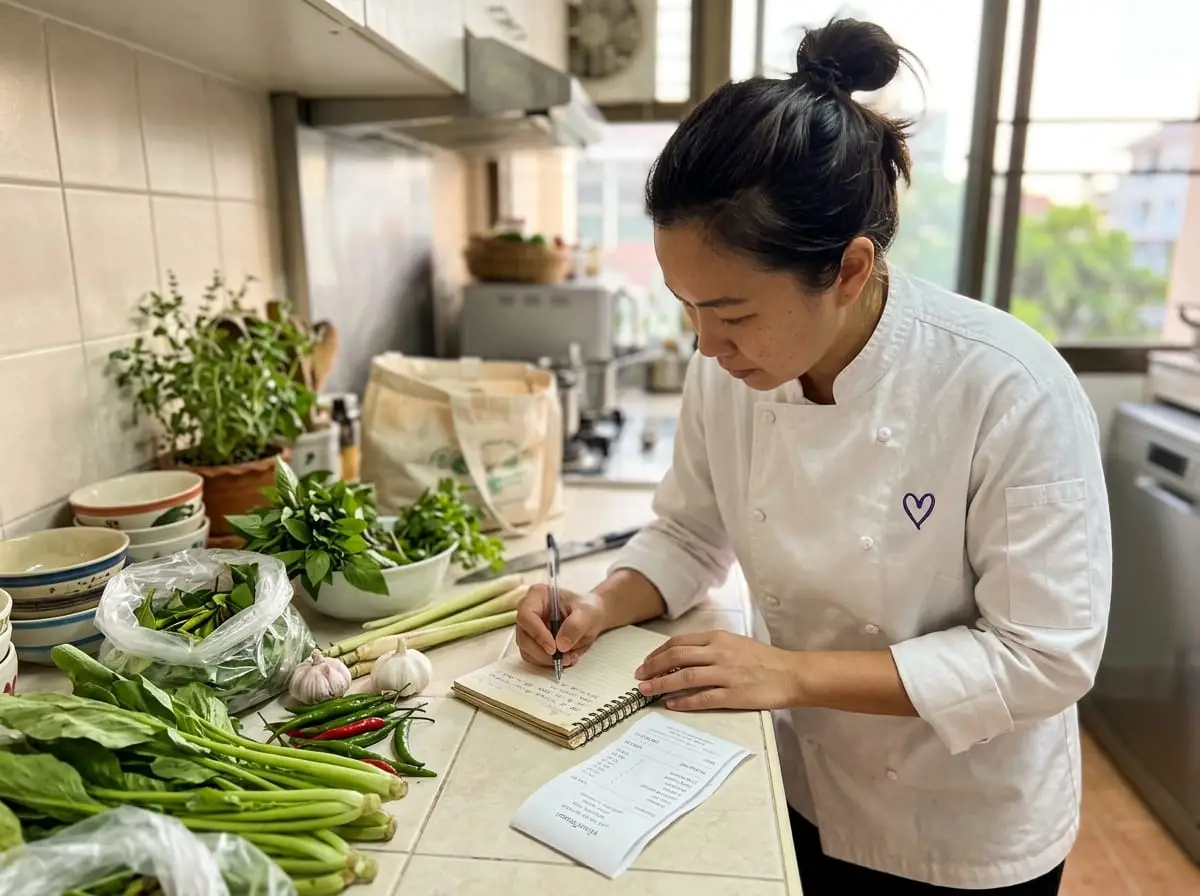
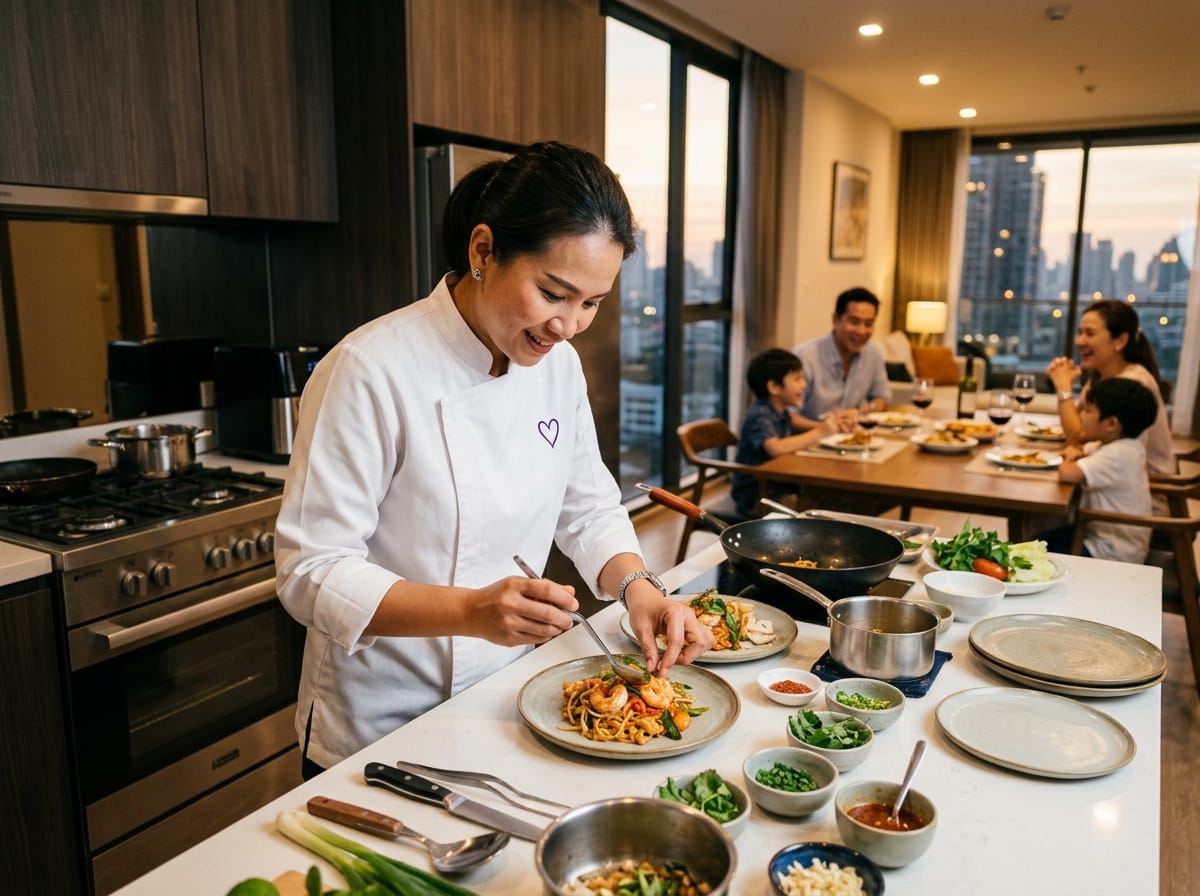
Italian food is what most hosts ask for when they want a dinner party that pleases everyone. Children eat pasta, grandparents trust it, the person who does not eat chilli is safe, and it fits a long table with a few bottles of wine. An Italian private chef in Bangkok can turn a condo kitchen into a trattoria for an evening, and the same chef can cook the weeknight suppers that keep children eating vegetables.
Italian is also full of ingredients that do not enjoy Bangkok's climate: raw egg in tiramisu, soft cheese, cured meat and fresh pasta dough that turns sticky in 80% humidity. This guide covers three real menus with costs, how a chef times pasta and risotto in a hot kitchen, the allergens on a typical Italian table, and how to keep it all safe.
Why Italian is the most-booked dinner-party cuisine
Of all the cuisines families ask us to cook for guests, Italian comes up most, and the reasons are practical rather than romantic.
It suits mixed tables. A dinner party in Bangkok often includes Thai, European, Indian and Japanese guests, children and an older relative or two. Italian food is familiar to all of them and rarely needs explaining.
It handles dietary needs well. Vegetarian guests get a proper primo rather than a side salad. Gluten-free guests have risotto and polenta. A pescatarian is happy with a whole roasted fish. Very little needs to be invented from scratch.
It is built for sharing. Family-style platters of antipasti and a big dish of pasta in the middle of the table make an evening feel generous without requiring a chef to plate eight identical courses.
The theatre is in the kitchen. Watching fresh pasta being rolled and cut is part of the evening, especially for children, who can be given a small ball of dough of their own.
Where Italian dinner parties go wrong
The common failures are not about cooking skill. They are too many courses for one chef to keep hot, cream sauces that sit heavily on a hot night, and antipasti boards that stay on the table for three hours. A strong Italian dinner in Bangkok is lighter than its European cousin: one pasta, one main, plenty of vegetables, a cold dessert, and a chef who clears food away rather than leaving it out to be grazed on.
The catch is that good Italian food depends on a few excellent ingredients, and most of those are imported. That is where the budget goes, and where a chef who knows Bangkok's suppliers earns the fee.
Three menus: dinner party for eight, Sunday family lunch, weeknight children's suppers
Dinner party for eight
| Course | Dish | Notes |
|---|---|---|
| Aperitivo | Rosemary focaccia, marinated olives, burrata with tomatoes from Chiang Mai | Burrata out of the fridge only when guests sit down |
| Antipasto | Prosciutto with Thai cantaloupe; grilled courgette with mint and lemon | Cured meat plated last, kept chilled |
| Primo | Hand-cut tagliatelle with slow-cooked beef ragù, or porcini and thyme risotto | Gluten-free guests get the risotto |
| Secondo | Whole roasted sea bass with salsa verde, or lamb shoulder with rosemary | Fish cooked to 63 °C in the thickest part |
| Contorni | Roast potatoes with garlic; rocket and Parmigiano salad | Dressing on the side for children |
| Dolce | Tiramisu with a cooked zabaglione base, or panna cotta with mango | Both made the day before and kept chilled |
Sunday family lunch for six
| Dish | Why it works |
|---|---|
| Lasagne with béchamel and ragù | Made in the morning, rests while guests arrive, feeds children and adults alike |
| Lemon and garlic roast chicken with potatoes | One tray, minimal attention, cooked to 74 °C at the thigh |
| Green salad and focaccia | The chef bakes the focaccia while the lasagne rests |
| Affogato for adults, gelato for children | No preparation, no raw egg |
Weeknight children's suppers
| Evening | Supper | Hidden vegetables and protein |
|---|---|---|
| Monday | Minestrone with small pasta and cannellini beans, cheese toast | Carrot, celery, courgette, beans |
| Tuesday | Oven-baked chicken Milanese with tomato salad | Breadcrumbs baked, not fried |
| Wednesday | Baked salmon with lemon orzo and peas | Oily fish for omega-3 |
| Thursday | Home-made pizza, children choose toppings | Peppers, mushrooms, spinach, ham |
| Friday | Pasta e fagioli or a mild pesto pasta with green beans and potato | Beans, greens, olive oil |
What the evening costs and what is extra
The chef's fee and the ingredients are two separate numbers, and the ingredients vary far more.
| Item | Guide cost | What decides it |
|---|---|---|
| Chef, dinner party up to six guests | ฿5,900 (CareRova guide rate) | Fixed for up to six; larger groups quoted |
| Chef, dinner for eight or more | Quoted on request | Menu complexity, whether a second pair of hands is needed |
| Chef, Sunday lunch (four-hour minimum) | ฿900 an hour | Usually four to five hours including shopping and clean-up |
| Ingredients for eight, local produce and one imported cheese | ฿5,000–8,000 | Thai-made burrata, local fish, chicken |
| Ingredients for eight, imported-heavy | ฿10,000–15,000 | Burrata flown from Italy, Parma ham, lamb or beef, aged Parmigiano |
| Weeknight family cooking | ฿19,900 a month part-time; ฿34,900 full-time | All-in, groceries at cost |
What is included in the chef's fee: menu planning, the shopping trip, cooking, plating or family-style service, and leaving the kitchen clean. What is extra: ingredients, which are bought on your account or reimbursed from receipts at cost, and any serving staff for larger parties. Wine is your own.
Imported vs local
Imported Italian ingredients carry import duty and air freight, so they are expensive in Bangkok. The best chefs spend that money where it shows and buy locally where it does not. Parmigiano Reggiano, good extra-virgin olive oil, 00 flour, canned San Marzano tomatoes and Parma ham are worth importing. Basil, rocket, cherry tomatoes and courgettes grown in northern Thailand are excellent. Thai-made mozzarella and burrata are now very good, fresher than anything that has spent a day in transit, and much cheaper.
Families in Thonglor and Ekkamai are well placed: the area has several imported-food shops and delis, and a chef can usually collect everything in one trip. For a fuller explanation of how chef formats compare, see our guide to private chef costs in Bangkok.
Fresh pasta, risotto and timing a hot kitchen
Italian dinner parties fail in the last twenty minutes, when pasta, risotto and a main course all need attention at once. A professional chef plans the timing backwards from the moment the primo is served.
Fresh pasta in Bangkok humidity
Egg pasta dough is simple: 00 flour, eggs, a pinch of salt. In Bangkok it behaves differently. Humidity makes the dough sticky, so chefs work with a little more semolina for dusting, keep the dough wrapped and chilled while it rests, and roll it out in an air-conditioned room rather than a hot kitchen. Hanging pasta to dry for hours, as you might in Italy, invites mould in Bangkok air. Fresh pasta is either cooked within a couple of hours or frozen on a floured tray.
Filled pasta such as ravioli with ricotta is a higher-risk food because of the soft cheese filling. It should be made on the day, kept chilled until it goes into the water, and frozen rather than refrigerated if it will not be eaten that evening.
Risotto without being chained to the stove
A risotto takes about 18 to 20 minutes from the moment the rice goes in. For a dinner party, chefs par-cook it: the rice is cooked for about 12 minutes, spread thinly on a tray to cool quickly, chilled, and then finished with hot stock in about six minutes when guests are ready. The safety point is the cooling. Cooked rice left warm is a classic source of Bacillus cereus, so the par-cooked rice must be chilled within the hour, not left on the counter.
Condo kitchens
Many Bangkok condos have a two-zone induction hob and one small oven. A large pot of pasta water takes up half the hob and fills the room with steam. A chef working in a condo will usually:
- Bake focaccia and make dessert the day before or early in the afternoon
- Use the oven for the main course and keep the hob free for pasta and sauce
- Cook pasta in two batches rather than one huge pot
- Run the cooker hood and aircon throughout, which matters for the chef as much as for the food
A run sheet for the last hour
For a 7:30 pm dinner for eight with tagliatelle and roast sea bass, a chef's final hour typically looks like this:
- 6:30 pm. Pasta water on in two pots. Ragù reheated gently and held hot above 60 °C. Fish scored, seasoned and on a tray in the fridge.
- 6:50 pm. Burrata and prosciutto plated straight from the fridge as the first guests arrive. Focaccia warmed.
- 7:15 pm. Fish into a hot oven. Rocket washed, dressing made, salad left undressed.
- 7:30 pm. Tagliatelle into boiling water for two to three minutes, tossed with the ragù and sent out within a minute of draining.
- 7:50 pm. Fish checked with a probe at the thickest point, rested, then plated with salsa verde and potatoes.
- 8:30 pm. Antipasti boards cleared and leftovers chilled. Tiramisu comes out of the fridge only when the plates are cleared.
The detail worth noticing is that cold food stays cold until the last moment and hot food stays hot. Most dinner-party food poisoning comes from the long middle of the evening, not from the cooking itself.
Gluten, dairy, egg and nut allergens on an Italian menu
Italian cooking uses most of the major allergens, often in places guests do not expect. The UK Food Standards Agency's guidance on allergy and intolerance lists 14 major allergens; an Italian menu can contain nine of them.
| Allergen | Where it hides on an Italian table | Safe swap |
|---|---|---|
| Gluten (wheat) | Pasta, focaccia, breadcrumbs, flour-dusted meat, some sausages | Risotto, polenta, gluten-free pasta cooked separately |
| Milk | Burrata, Parmigiano, béchamel, butter in risotto, panna cotta | Olive oil finishes, dairy-free pesto, sorbet |
| Egg | Fresh pasta, tiramisu, carbonara, aioli, some breadcrumb coatings | Dried durum wheat pasta (egg-free), fruit desserts |
| Tree nuts | Pesto (pine nuts and sometimes cashews), amaretti, frangipane, pistachio | Basil and rocket oil without nuts |
| Fish | Anchovies in salsa verde and puttanesca, vitello tonnato | Salsa verde without anchovy, labelled |
| Celery | Soffritto base in ragù, minestrone and many stocks | Carrot and onion soffritto |
Gluten and coeliac disease
Gluten-free pasta alone does not make a coeliac guest safe. Pasta water carries gluten, a colander holds starch from the last batch, and a board dusted with flour contaminates anything on it. The chef should cook gluten-free pasta first in fresh water in a separate pot, drain it through a clean colander, and plate it before the wheat pasta is touched.
Milk allergy vs lactose intolerance
These are different problems. Aged Parmigiano is almost lactose-free and many lactose-intolerant guests eat it happily, but a milk-allergic guest reacts to the milk protein and must avoid it entirely. Ask guests which they have, not just whether they "avoid dairy".
Nuts
Pesto is the most common trap. Many shop-bought pestos use cashews instead of, or alongside, pine nuts. A chef should make pesto from scratch for any party with a nut allergy, or leave it off the menu. FARE's food allergy resources explain how cross-contact happens through shared spoons and boards, which is the usual cause of a reaction at a home dinner.
Cured meats, soft cheeses, tiramisu: keeping Italian food safe in 32 °C
The traditional Italian table assumes a cool cellar and a mild evening. A Bangkok terrace at 9 pm is often 30 °C or more, and that changes the rules.
The one-hour rule for antipasti
The USDA danger zone guidance gives two hours as the limit for perishable food at room temperature, and one hour above 32 °C. A board of burrata, prosciutto and marinated vegetables on an outdoor table should be cleared after an hour and replaced, not topped up. Indoors with aircon, two hours is the outer limit.
Cured meats
Sliced prosciutto, salami and mortadella should be kept chilled until they are plated. Once a pack is opened, the FoodSafety.gov cold storage chart gives three to five days in the fridge for sliced deli meat. Pregnant guests need care here: the NHS's pregnancy guidance notes that cold cured meats are not cooked and can carry toxoplasmosis, and that freezing them for four days or cooking them makes them safer.
Soft and fresh cheese
Burrata and fresh mozzarella are perishable and should be eaten within days of purchase, kept at 5 °C or below until serving. The same NHS guidance advises pregnant women to avoid mould-ripened and soft blue cheeses such as gorgonzola unless they are cooked until steaming hot, while hard cheeses such as Parmigiano are fine. Your fridge temperature matters more than people think; the FDA's refrigerator thermometer advice explains why a cheap thermometer is worth having.
Eggs: tiramisu, carbonara and aioli
Traditional tiramisu uses raw egg yolks and whites folded into mascarpone. Raw egg carries a salmonella risk, and eggs in Thai supermarkets are not generally pasteurised. A careful chef cooks the yolks with sugar over simmering water into a zabaglione that reaches 71 °C, the egg-dish temperature in the FoodSafety.gov minimum temperature chart, and either leaves out the raw whites or uses pasteurised ones. Carbonara relies on residual heat and often does not get that hot; for children and pregnant or older guests the chef can finish the sauce over a low flame until it thickens. Home-made aioli is raw egg, full stop.
Leftovers
Lasagne, ragù and roast chicken are excellent the next day if they are cooled and refrigerated within two hours of cooking. Large trays should be divided into shallow containers so they cool quickly. Tiramisu keeps two days in the fridge; burrata that has sat on the table does not keep at all.
The Mediterranean pattern for children and parents
The Mediterranean eating pattern is one of the best-studied diets in nutrition research. The Mayo Clinic's overview of the Mediterranean diet summarises it well: vegetables, fruit, whole grains, beans, nuts and olive oil as the base, fish and poultry several times a week, red meat occasionally. Large trials catalogued on PubMed, including the Spanish PREDIMED study, have linked it with lower rates of heart disease in adults.
For families, the useful point is that real Italian home cooking is much closer to this pattern than restaurant Italian. A Tuesday in an Italian home is more likely to be minestrone, beans with greens or grilled fish than a cream sauce.
What it looks like in a Bangkok week
- Beans twice a week: pasta e fagioli, minestrone, chickpeas with spinach
- Fish twice a week: local sea bass, snapper or imported salmon, baked with lemon and herbs
- Vegetables in everything: Thai-grown courgettes, aubergines, peppers and tomatoes are cheap and good
- Olive oil as the main fat, with butter kept for occasional risotto and baking
- Pasta as a course, not a mountain: a child's portion is roughly a cupped handful of dry pasta, served with vegetables and protein
- Fruit for dessert most nights: mango, papaya and pineapple are ideal
Harvard's Nutrition Source is a good reference for the healthy-fats case for olive oil and nuts, and the American Academy of Pediatrics' nutrition pages for families cover portion sizes and picky eating by age.
The adjustments for children
Salt is the main one. Parmigiano, cured meats, olives and anchovies are all salty, so a children's portion should go easy on all four. Pasta water should be salted for flavour, not "like the sea". Whole-wheat pasta is worth trying in half-and-half mixes, which most children accept without comment.
How to brief an Italian chef and book
A good brief makes the difference between a generic pasta night and a menu that fits your table.
What to send
- Date, time and guest count, with the number of children and their ages
- Every dietary restriction: coeliac or gluten-free by choice, milk allergy or lactose intolerance, egg, nuts, pregnancy, vegetarian or vegan
- The style: plated courses, family-style platters, or a relaxed Sunday table
- Your kitchen: hob type, oven size, fridge space, and where guests will sit
- Your ingredient budget, so the chef can choose between local burrata and imported, or sea bass and lamb
- Weekly cooking, if you would like the same chef for family suppers afterwards
Kitchen hygiene to expect
Every chef CareRova places holds food-hygiene certification, has passed a police background check and has had at least two references phoned. On the night you should see hands washed before handling food and after raw meat, a separate board for raw meat and fish, a probe thermometer in use, cheese and cured meat kept chilled until the last minute, and the kitchen left clean. Wiping cloths should be fresh for the evening and changed often; the UK Food Standards Agency's cleaning guidance explains why a damp cloth that has been in use all day spreads more bacteria than it removes.
One rule is non-negotiable. A chef who has had vomiting or diarrhoea in the previous 48 hours does not cook for your party, even if they feel fine by the afternoon. We would rather send a replacement than risk a table of guests, and a good chef will tell you the moment it happens.
A tasting before a big occasion
For a milestone birthday or an anniversary dinner, it is worth booking the chef for a smaller meal first, at ฿900 an hour with a four-hour minimum. You taste the ragù and the tiramisu, the chef sees your kitchen and oven, and the menu for the big night can be adjusted with real information. It also tells you whether the chef's timing suits your household before twelve guests are waiting. For guests with plant-based diets, our vegan private chef guide has menu ideas, and our dinner party hosting guide covers serving staff, timings and guest surveys.
Booking
The chef rates are on the pricing page: ฿5,900 for an in-home dinner for up to six, ฿900 an hour with a four-hour minimum, ฿4,900 a day, ฿19,900 a month part-time and ฿34,900 full-time. Read more about the private chef service, then send your date, guest list and restrictions to CareRova on WhatsApp at +66 97 120 3054 or through the contact form. You will have a shortlist of chefs within 48 hours.
Frequently asked questions
How much does an Italian private chef cost in Bangkok?
CareRova's guide rate for an in-home dinner is ฿5,900 for up to six guests, plus ingredients at cost. Groups above six are quoted. For weekday family cooking, a part-time chef is ฿19,900 a month and full-time ฿34,900, all-in.
Can an Italian chef cook gluten-free?
Yes. Risotto, polenta, most meat and fish mains and many desserts are naturally gluten-free, and gluten-free pasta is easy to buy in Bangkok. For coeliac guests the chef must also use a separate pot of water, a separate colander and a clean board.
Is homemade tiramisu safe?
Traditional tiramisu uses raw egg, which carries a salmonella risk. A safer version cooks the yolks and sugar over simmering water into a zabaglione that reaches 71 °C, or uses pasteurised eggs, and the finished dessert stays in the fridge until it is served.
Does a private chef make fresh pasta at home?
Yes. A chef can make tagliatelle, pappardelle or filled pasta in your kitchen in about an hour. In Bangkok humidity the dough needs a little more semolina and less resting time out of the fridge, and filled pasta should be cooked the same day or frozen.
Where do Italian chefs buy ingredients in Bangkok?
Imported cheese, cured meat, 00 flour and olive oil come from supermarkets and Italian importers, while tomatoes, basil, rocket, courgettes and fish are often bought locally. Thai-made mozzarella and burrata are fresh, good and far cheaper than cheese flown in from Italy.
Need someone properly vetted?
Get a written rate for your household in under 60 seconds.
Written by the CareRova team
We're Bangkok's vetted home-care agency — everything we write comes from real nanny, chef, housekeeper and senior-care placements across condos, houses and short-stay villas.
Get our Bangkok family-care guides straight in Google — add CareRova as a preferred source.