
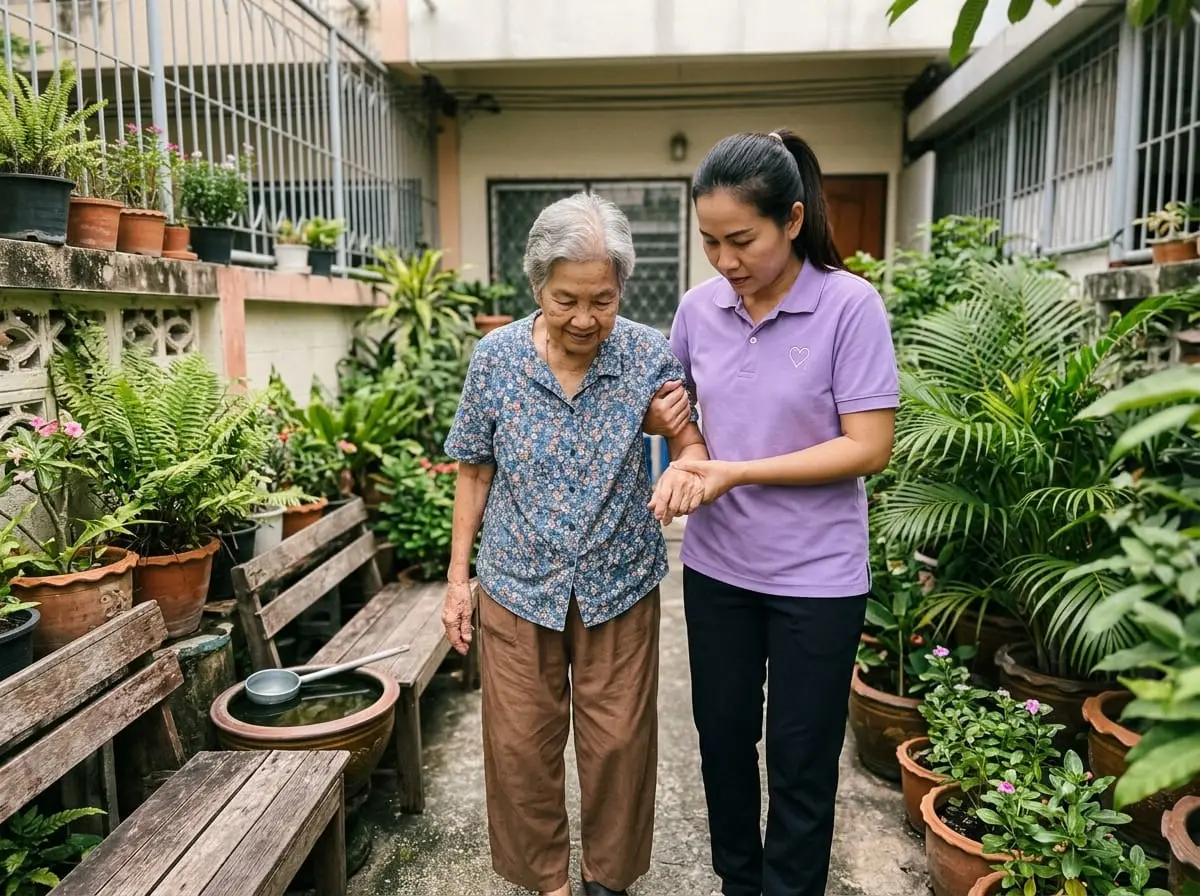
Most families start thinking about dementia care at home in Bangkok after a moment that frightens them: a parent found in the lobby at midnight, a pan left burning, a fall in the bathroom. Until then, the forgetting was manageable. After it, someone needs to be there.
Home is usually the right place for someone with dementia. Familiar rooms, familiar food and familiar faces reduce distress, and a good carer can keep a parent comfortable and safe at home for a long time. But home care for dementia is a different job from general elderly care. It needs routine, patience, changes to the home, and a plan for nights and for the family's own stamina.
This guide covers what dementia care at home looks like, the carer's day, safety changes, meals and fluids in the heat, hygiene and infection, night-time, family burnout, and what it costs. It is practical, not medical: the diagnosis, medicines and clinical decisions belong with your parent's geriatrician or neurologist.
What dementia care at home looks like in Bangkok
Dementia is an umbrella term for conditions, Alzheimer's disease among them, that progressively affect memory, thinking and daily function. Care needs change as the condition progresses, so the arrangement you start with is rarely the one you end with.
Care by stage
| Stage | What families usually notice | Typical care at home |
|---|---|---|
| Early | Forgetting recent events, repeating questions, trouble with money or medicines | A few days a week of help, medicine prompts, company and outings |
| Middle | Getting lost, confusion about time and place, needing help to wash and dress, restlessness late in the day | Full-time day care, then live-in; home safety changes; night support as needed |
| Later | Needing help with most personal care, eating and drinking, walking; sleeping more | Live-in plus a second carer or night carer; nursing input arranged with the doctor |
These are broad patterns, not a clinical staging system; your parent's doctor is the right person to say where they are and what to expect.
What a carer does, and what she does not
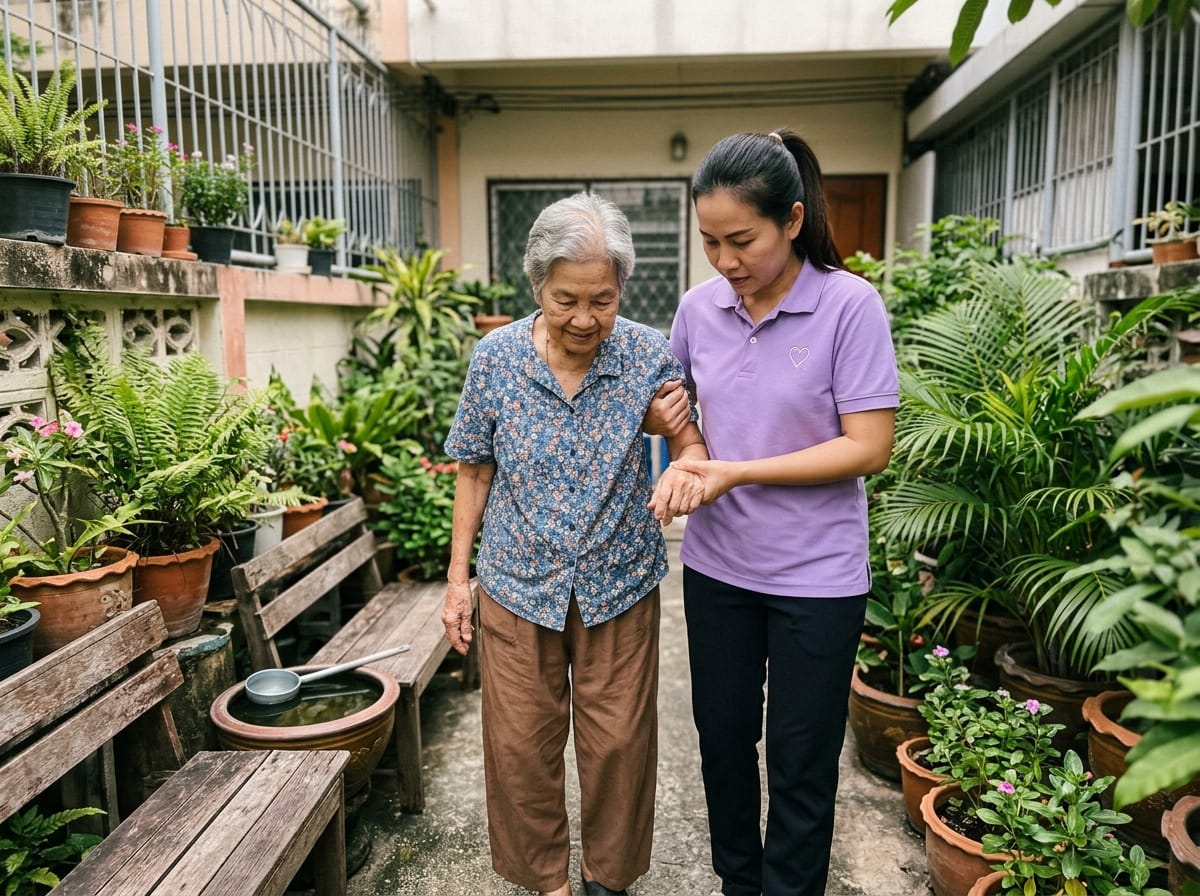
A trained senior carer helps with washing, dressing, toileting, meals and drinks, walks, activities, medicine prompts, light tidying of the person's room and laundry, and accompanies them to appointments. She keeps a daily log and notices change.
A carer is not a registered nurse. Injections, wound dressings, catheter care, tube feeding and medication changes are nursing or medical tasks. If your parent needs them, ask the hospital or doctor to arrange nursing input alongside the carer.
Experience matters more than in any other role
Dementia care asks for skills general elderly care does not: answering the same question for the tenth time as kindly as the first, redirecting instead of arguing, staying calm when a parent accuses the carer of stealing a misplaced wallet. When CareRova matches senior carers for dementia, we ask for references from families caring for someone with the same condition. Our overview of elderly care at home in Bangkok covers the broader options and post-hospital care.
Routine, orientation and the carer's day
Routine is the most effective tool a dementia carer has. When every day has the same shape, the person has fewer decisions to make, fewer surprises and less reason to feel lost.
A typical day
| Time | What happens | Why |
|---|---|---|
| 07:00 | Wake, toilet, wash, dress in clothes laid out in order | Same order every morning reduces confusion |
| 08:00 | Breakfast, medicine prompt, first drink logged | Medicines with food as prescribed |
| 09:00 | Walk in the lobby, garden or park while it is cool | Daylight and movement help sleep later |
| 10:30 | Drink and snack, an activity | Fluids before the heat of the day |
| 12:00 | Lunch | Main meal earlier if appetite fades later |
| 13:00 | Rest, but not a long sleep | Long afternoon naps can unsettle nights |
| 15:00 | Activity or visitors: music, photos, folding laundry | Meaningful tasks reduce restlessness |
| 16:30 | Drink, lights on before dusk | Helps with late-afternoon agitation |
| 17:30 | Early dinner | Avoids eating while tired and confused |
| 19:00 | Quiet time, wash, change for bed | Calm, predictable wind-down |
| 20:30 | Bed; night light on; log completed | Family can read the day at a glance |
Orientation without testing
A large clock with the day and date, a whiteboard with the day's plan, familiar photographs, and the carer naming herself and what comes next all help. What does not help is quizzing: "Do you know what day it is?" makes a person with dementia feel tested and anxious. The carer offers information gently instead: "It's Tuesday morning; your daughter is coming for lunch."
Communication that works
- Approach from the front, make eye contact and use their name.
- One short instruction at a time: "Let's stand up," then "Now let's walk to the bathroom."
- Give time to answer; do not rush or finish sentences.
- Do not argue with a mistaken belief. Acknowledge the feeling and redirect.
- Use the language they are most comfortable in. Many people return to their first language as dementia progresses, which matters for Thai-Chinese, Thai and expat families alike.
Activity and movement
The WHO's physical activity guidance recommends that older adults include activities that improve balance and strength on three or more days a week, partly to prevent falls. For someone with dementia, that may be a supported walk every morning, standing and sitting exercises from a physiotherapist, or chair-based movement to music. Familiar activities count too: watering plants, folding towels, a morning visit to the temple to give alms, if that was part of their life.
Medicines
The carer prompts and assists with medicines exactly as prescribed, from a labelled weekly organiser that a family member or pharmacist fills, and records each dose. She never changes a dose, skips one without telling you, crushes tablets or gives anything new, including herbal remedies, without the doctor's or pharmacist's instruction. Medicines are kept locked when not in use.
Making the home safe: stove, doors, bathroom, lighting
Most accidents at home happen in the kitchen, the bathroom and at night on the way to the toilet. A few changes, done before an incident rather than after, make the biggest difference. An occupational therapist, whom your hospital can often arrange, is the best person to assess your home.
The safety checklist
Kitchen
- Fit a gas shut-off valve the person cannot reach, or switch to an induction hob with automatic shut-off.
- Remove or cover the knobs when the carer is not cooking.
- Lock away knives, cleaning products and anything that could be mistaken for food or drink.
- Check the fridge daily for out-of-date food; people with dementia may hide or forget food.
Doors, windows and balconies
- Fit a chime or alarm on the front door so the carer hears it open.
- Keep balcony doors and windows locked, with keys out of sight. In a high-rise condo, this is the single most important change.
- Give the building's security team a recent photo of your parent and your phone number, and ask them to call you if they see your parent leave alone.
- Give your parent an ID bracelet or card with a contact number in Thai and English.
Bathroom
- Fit grab rails by the toilet and in the shower, and use a non-slip mat and a shower chair.
- Turn the water heater down so tap water cannot scald.
- Remove the inside lock from the bathroom door, or fit one that opens from outside.
- Use a toilet seat in a contrasting colour so it is easier to see.
Lighting and floors
- Night lights from the bed to the bathroom.
- Even lighting during the day with fewer dark corners and less glare.
- Remove loose rugs, trailing cables and clutter from walking routes.
Medicines and money
- All medicines locked away, including the family's.
- Valuables, bank cards and documents kept somewhere secure, to avoid both loss and accusations.
Air and mould
Bangkok bathrooms grow mould quickly, and a person with dementia may not report breathing problems. Keep bathrooms ventilated and clean any visible mould promptly, following the US EPA's mould guidance. During PM2.5 season, roughly December to March, the carer checks the reading on IQAir's Bangkok page before the morning walk and stays indoors with the purifier on when the air is poor. If the home needs a deep clean before care starts, our sister company CleanRova does that in Bangkok.
Meals, swallowing and hydration in the heat
Eating and drinking change with dementia. People forget meals, forget they have eaten, lose interest in food, struggle with cutlery or, later, have difficulty swallowing. In Bangkok's heat, poor drinking is the most immediate risk.
Making meals work
- Serve meals at the same times, at the same table, with few distractions.
- Use plain plates in a colour that contrasts with the food.
- Offer one or two foods at a time rather than a full spread.
- Finger foods help when cutlery becomes hard: sticky rice, pieces of omelette, steamed dumplings, soft fruit.
- Smaller, more frequent meals often work better than three large ones.
- Familiar food from their own past is more likely to be eaten than something new.
A balanced pattern rich in vegetables, fruit, whole grains, fish and olive oil, like the Mediterranean diet described by Mayo Clinic, suits most older adults, but appetite and any other condition, such as diabetes, come first. The Harvard Nutrition Source is a sound general reference. If weight is falling, tell the doctor.
Swallowing
Coughing or choking during meals, a wet or gurgly voice after drinking, holding food in the mouth for a long time, or repeated chest infections can be signs of a swallowing problem. These need assessment by the doctor and a speech and language therapist, who may recommend softer textures or thickened drinks and the right sitting position. The carer follows that plan exactly and never changes textures on her own judgement. The person always eats sitting upright, never lying back in bed.
Hydration in Bangkok heat
People with dementia often feel thirst less and forget to drink. Dehydration can make confusion worse, raise the risk of falls and urinary infections, and develop quickly when it is 34 °C outside. The carer:
- Offers a drink every hour or so while awake, in a cup the person can manage.
- Logs every drink, so the family can see the daily total.
- Uses foods with a lot of water: watermelon, soups, jelly, congee.
- Watches for dark urine, dry mouth, dizziness or sudden extra confusion, and tells you.
Some people have a fluid limit because of heart or kidney conditions. Ask the doctor what the right daily amount is for your parent and write it on the care plan.
Food safety for someone vulnerable
Older adults are more vulnerable to foodborne illness, as the WHO's food safety fact sheet notes. Hot food is eaten hot; leftovers are cooled and in the fridge within two hours, because bacteria multiply fastest between 5 °C and 60 °C, as the USDA's danger zone guidance explains. The fridge stays at 5 °C or below, every container is labelled with a date, and anything uneaten from a plate goes in the bin. Families who add a cook for batch meals should read our guide to weekly meal prep and fridge safety.
Hygiene and infection: skin, continence, UTIs
Personal care is the most intimate part of dementia care and the one most likely to cause distress. Done well, it protects skin, prevents infection and preserves dignity.
Washing without a battle
Many people with dementia resist bathing: the noise of the shower, the cold of a wet body, the feeling of being undressed by someone they do not quite recognise. The carer makes the bathroom warm, explains each step, keeps the person covered with a towel, lets them do what they can themselves, and chooses the time of day when they are calmest. On difficult days, a gentle wash at the sink is better than a fight in the shower.
Skin
In Bangkok's heat and humidity, skin folds stay damp and can develop rashes or fungal infections. The carer dries carefully under the breasts, in the groin and between the toes, and checks the skin daily during washing. For anyone sitting or lying for long periods, she watches the pressure points, such as heels, hips and the base of the spine, for redness that does not fade, and follows the nurse's or doctor's advice on changing position.
Continence
Incontinence is common in middle and later dementia. Practical steps help: a regular toilet routine every two to three hours, clothes that are easy to remove, a clear path and a light to the toilet. Pads are changed promptly, the skin is cleaned gently front to back and dried, and any barrier cream is used as the nurse advises. Soiled laundry is bagged and washed hot.
Infections and sudden confusion
A urinary tract infection, chest infection or dehydration can make someone with dementia suddenly much more confused, agitated or drowsy, sometimes without the usual symptoms. A sharp change over hours or days is a reason to call the doctor the same day. The carer records temperature, drinks and toilet changes so the doctor has facts to work with.
Everyday infection control
- Handwashing with soap for at least 20 seconds before food, after toileting and after handling pads, as the CDC's handwashing guidance advises.
- Separate cloths for the bathroom and kitchen.
- A carer with vomiting, diarrhoea or fever stays home; norovirus spreads quickly through households, as the CDC's norovirus page explains.
- Ask the doctor about flu and other vaccines for your parent; the CDC's vaccine information explains why they matter more with age.
- During rainy season, screens on windows and a net over the bed reduce mosquito bites; the WHO's dengue fact sheet describes the warning signs.
Night-time: wandering, sleep and night carers
Nights are where home care most often breaks down. A parent who is up three times a night, tries to leave the flat at 2 am or calls out for someone who died years ago wears out the family faster than anything that happens in daylight.
Late-day agitation
Many people with dementia become more confused, anxious or restless in the late afternoon and evening, sometimes called sundowning. The carer turns lights on before dusk, keeps the evening quiet and predictable, avoids caffeine after lunch, and makes sure the day has had enough activity and daylight.
Wandering at night
- Door chime or alarm on the front door, and balcony doors locked.
- A sensor mat or bed alarm, if the doctor or occupational therapist suggests one.
- Night lights to the bathroom, so a trip to the toilet does not become a search for the toilet.
- A toilet visit just before bed and a drink earlier in the evening rather than late.
- Never use restraints or lock the person in the bedroom.
If your parent is sleeping very badly, ask the doctor. The carer does not give sleeping tablets or any sedating medicine unless it has been prescribed, and even then only as directed.
Choosing the right night cover
| Night pattern | Suitable arrangement |
|---|---|
| Sleeps through, or wakes once for the toilet | Live-in carer, with her own room and a monitor |
| Wakes two or three times, settles easily | Live-in carer plus regular night support, or family taking some nights |
| Up repeatedly, tries to leave, needs help each time | Awake night carer, separate from the day carer |
| Needs turning or nursing care at night | Night carer plus nursing input arranged by the doctor |
A live-in carer is not a 24-hour carer. She needs unbroken sleep and at least one day off a week, which is part of the legal baseline for domestic workers in Thailand set by the Department of Labour Protection and Welfare. If she is up all night, she cannot give safe care the next day.
When to go to hospital
Call 1669 for breathing difficulty, chest pain, collapse, a fall with a head injury or a seizure. Same-day review is needed for a fever, a sudden worsening of confusion, a fall without obvious injury, or refusing food and drink. Hospitals such as Bumrungrad, Bangkok Hospital and Samitivej run 24-hour emergency departments; keep your parent's medicine list and a copy of their ID in a bag by the door.
Family carers, burnout and rotation
Most dementia care in Thailand is still given by family, usually a daughter or daughter-in-law, often alongside a job and children. The cost is real: exhaustion, isolation and guilt are common, and a carer who collapses cannot help anyone.
Signs a family carer needs relief
- Sleeping badly most nights because of the person's care.
- Feeling irritable, tearful or resentful most days.
- Dropping their own doctor's appointments, exercise or friendships.
- Feeling that nobody else can do it properly.
Harvard Health Publishing has accessible articles on caregiver stress, and caregiver strain in dementia is one of the most widely studied topics in the research indexed on PubMed. The fix is not more willpower; it is more hands.
Building a rotation
- Respite days. A senior carer for one or two days a week, at ฿3,200 a day, gives the main family carer a full day off.
- Covering the paid carer's day off. A live-in carer needs a weekly day off; plan who covers it, whether a family member or a second carer.
- Splitting days and nights. If nights are hard, a night carer lets the family sleep and the day carer work safely.
- Family meeting. Once a month, agree who does what: doctor's visits, money, medicines, visits. Write it down.
Employment basics if you hire directly
If you employ a carer yourself rather than through an agency, the carer is entitled to at least one day off a week, paid public holidays and sick leave, and a foreign carer needs a valid work permit for the role. You may register her with the Social Security Office. With a CareRova placement, we handle the arrangement, monthly check-ins and cover when a carer is ill.
Costs, the care plan and how to book
CareRova's senior-care guide rates for 2026 are all-in: police background check, ID and work-eligibility check, two or more phoned references, a paid trial day, monthly check-ins and, on long-term placements, a 90-day free replacement.
| Arrangement | Typical use | Guide rate |
|---|---|---|
| Hourly | Appointments, family errands, 4-hour minimum | ฿500 an hour |
| Daily | Respite days, 8 hours | ฿3,200 a day |
| Part-time | 3 days a week | ฿17,900 a month |
| Full-time, live-out | 5 to 6 days | ฿31,900 a month |
| Live-in | 6 days, room and meals provided | ฿28,900 a month |
| Night carer | Awake nights | Quoted individually |
| Home cook | Batch meals, 3 days a week | ฿19,900 a month |
| Placement only | You employ the carer directly | One month's rate, one-off |
A common middle-stage arrangement is a live-in carer at ฿28,900 plus a day carer for her four days off a month at ฿3,200 each, which comes to ฿41,700 a month, with night cover added if sleep breaks down. Families who want proper meals without the carer cooking often add a cook through our private chef service; our sibling guide on healthy eating with a private chef covers diabetes and blood-pressure diets.
What goes into the care plan
- Diagnosis and doctor's contact, plus the hospital you use.
- Medicines with times, from the current prescription.
- Daily routine, food likes and dislikes, any texture or fluid instructions.
- Mobility and toileting needs, and the safety changes made at home.
- What calms your parent, and what upsets them.
- Night pattern and who covers nights.
- When to call you, and when to call 1669.
Take the plan and a week of the carer's log to each appointment with your parent's geriatrician or neurologist. It turns "she's been more confused" into facts a doctor can act on.
See our senior care service and the full rate table on the pricing page. To get a shortlist of dementia-experienced carers within 48 hours, send us your parent's situation, the hours and nights you need and your area: WhatsApp or call +66 97 120 3054, email support@carerova.com, or use the contact form.
Frequently asked questions
How much does dementia care at home cost in Bangkok?
With CareRova, a full-time live-out senior carer is ฿31,900 a month and a live-in carer is ฿28,900 a month with room and meals provided. A single day is ฿3,200 and hourly care is ฿500 an hour with a 4-hour minimum. Night carers are quoted individually.
What does a dementia caregiver do at home?
A dementia carer keeps a steady daily routine, helps with washing, dressing, toileting and meals, prompts medicines as prescribed, keeps the person active and calm, watches for wandering and changes in health, and keeps a daily log. Nursing tasks such as injections or wound care need a nurse.
Is a live-in carer enough for someone with dementia?
Often, for the earlier stages, if the person sleeps reasonably well. A live-in carer still needs proper sleep and a weekly day off. If the person is up several times a night or wanders, add a night carer or a second carer so nobody is working day and night.
How do I stop a parent with dementia from wandering out of the condo?
Fit a chime or alarm on the front door, keep balcony doors locked, give the condo security team a photo and your phone number, and have your parent wear an ID bracelet with a contact number. A carer who keeps them active in the day also reduces restlessness at night.
When should a person with dementia see a doctor urgently?
If confusion gets suddenly worse over hours or days, after a fall, with a fever, or if they stop eating or drinking. These can be signs of an infection, dehydration or another treatable problem. Call 1669 for breathing difficulty, chest pain, collapse or a head injury.
Can a carer give my parent their medicines?
A carer can prompt and assist with medicines exactly as prescribed, from a labelled organiser the family or pharmacist has filled, and record each dose. She does not change doses, crush tablets or give anything new without the doctor's or pharmacist's instruction.
Need someone properly vetted?
Get a written rate for your household in under 60 seconds.
Written by the CareRova team
We're Bangkok's vetted home-care agency — everything we write comes from real nanny, chef, housekeeper and senior-care placements across condos, houses and short-stay villas.
Get our Bangkok family-care guides straight in Google — add CareRova as a preferred source.