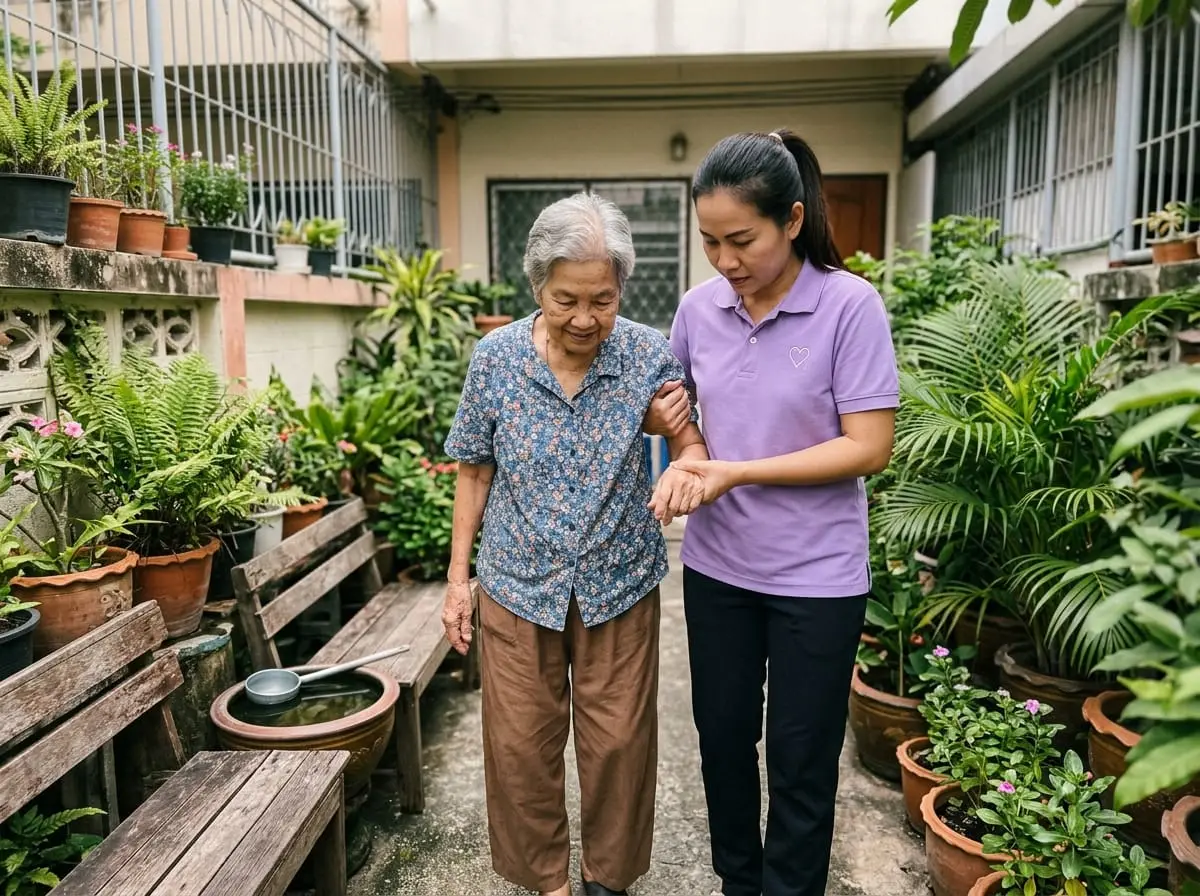
The call usually comes after a fall, a discharge or a stove left on. A parent who was managing is suddenly not, the family is across town or across the world, and the question is what home care actually looks like in Bangkok and what it costs. The honest answer is that there are four levels of care, most families need the second one, and the sooner you start the more choice you have.
The four levels
Companion carer. For a parent who is mostly independent but should not be alone all day: meals, a walk, medication reminders, appointments, company. Often part-time — three or four days a week — and the most affordable level.
Trained caregiver. The level most families end up needing. Everything the companion does plus personal care — bathing, dressing, toileting — and training for the common conditions: dementia, stroke recovery, diabetes, Parkinson's, post-surgical recovery. Caregivers in Thailand typically hold a 420-hour caregiver certificate from a Department of Health-approved course.
Nursing assistant. For parents with clinical needs that a caregiver should not handle alone — feeding tubes, catheters, oxygen, complex medication. Often combined with a caregiver for the daily-living side.
Registered nurse. For genuinely clinical care — injections, wound care, IV lines — usually on a visiting basis a few hours a day or week alongside a caregiver, rather than full-time.
The most common mistake is buying a nurse when a caregiver is needed, or a companion when a caregiver is needed. A short care call with someone who asks about mobility, continence, memory and medication sorts this out in fifteen minutes.
What it costs in 2026
| Engagement | Companion / caregiver | Nursing assistant |
|---|---|---|
| Hourly (min. 4 h) | ฿450–600 | ฿600–800 |
| Day (8 h) | ฿3,000–4,000 | ฿4,000–5,500 |
| Night shift (21:00–07:00) | ฿3,500–4,500 | ฿4,500–6,000 |
| Part-time, 3 days/week, monthly | ฿16,000–22,000 | ฿22,000–30,000 |
| Full-time, live-out, monthly | ฿28,000–40,000 | ฿38,000–55,000 |
| Live-in, monthly | ฿25,000–35,000 | ฿35,000–50,000 |
CareRova's senior-care guide rates are ฿500 an hour, ฿3,200 a day, ฿17,900 part-time, ฿31,900 full-time and ฿28,900 live-in, all-in — the carer's pay, matching and management, a written care plan, daily updates, sick cover and a 90-day replacement. Nurse-supervised plans and nursing assistants are quoted on the care call. The rates page shows all engagements side by side.
Post-hospital care
Hospitals in Bangkok tend to announce a discharge date a day or two before it happens. If a parent is in a ward and the word "home" has come up, brief an agency that day: the ward, the condition, the expected date, what the discharge instructions are likely to include. A carer can usually be ready within 48 hours, and it is far easier to reduce care in week three than to find it on the day of discharge.
Post-hospital care is usually the most intensive phase — full days or 24-hour cover for two to four weeks — before stepping down to part-time or nights.
Night care
Nights are where home care most often breaks down and where families wait longest to act. A parent who is unsettled after dark, who wanders, or who needs help to the bathroom two or three times a night needs a night carer, not a family member sleeping lightly. A 21:00–07:00 shift costs ฿3,500–4,500 and lets everyone else sleep. For parents who need someone present at all times, 24-hour live-in care with a private room for the carer is the arrangement that keeps most people at home.
Dementia and stroke
Ask specifically for carers with experience of the condition, and for references from families with the same condition. Dementia care is a different job from general elderly care — redirection rather than correction, routine over stimulation, patience with the same question ten times — and carers who have done it know that. Stroke recovery needs someone comfortable with transfers, exercises from the physiotherapist and the frustration of a parent who was independent last month.
What to check
Everything that applies to a nanny applies here: a police background check, ID and work eligibility, references that were called, a caregiver certificate where the role needs one. Then a meeting at home with the parent present — chemistry matters more in senior care than anywhere — and a paid trial day. And a written care plan, however simple: medication times, meals, mobility, what to do if, who to call.
The daily update
Insist on it. A short LINE message every afternoon — what was eaten, medication given, mood, mobility, anything to flag — with a photo when there is one. For a family in another district or another country, that message is the difference between knowing the care is happening and hoping it is. It is also how small changes get noticed early, which is most of what good elderly care is.
Frequently asked questions
How much does elderly home care cost in Bangkok?
In 2026, a trained caregiver costs ฿450–600 an hour, ฿3,000–4,000 for an 8-hour day, and ฿28,000–40,000 a month full-time live-out; live-in care runs ฿25,000–35,000 with room and meals. CareRova's guide rates are ฿500 an hour, ฿3,200 a day, ฿31,900 full-time and ฿28,900 live-in, all-in.
What is the difference between a caregiver and a nurse?
A caregiver handles daily living — meals, mobility, bathing, medication reminders, companionship — and may have dementia or stroke training. A nursing assistant or registered nurse handles clinical tasks: injections, wound care, catheters, tube feeding. Most families need a caregiver; a nurse is for specific clinical needs, often on a visiting basis.
Can a carer stay overnight?
Yes. Night shifts (21:00–07:00) suit parents who are unsettled, wander, or need help to the bathroom; 24-hour live-in care suits those who need someone present at all times. Night shifts start from around ฿3,500 in Bangkok.
Need someone properly vetted?
Get a written rate for your household in under 60 seconds.
Written by the CareRova Team
We're Bangkok's vetted home-care agency — everything we write comes from real nanny, chef, housekeeper and senior-care placements across condos, houses and short-stay villas.
Get our Bangkok family-care guides straight in Google — add CareRova as a preferred source.